



自動車用プラスチックモールディング: 内部, 外観, および構造部品ガイド
Automotive plastic molding is used to produce interior, exterior, and structural vehicle components with different tooling, 素材, and durability requirements. Interior parts focus on cosmetic finish quality, exterior parts need UV and impact resistance, and structural components require reinforced materials, より厳密な公差, and stronger mold engineering for long-term performance.
Modern vehicles depend on molded plastic parts far beyond simple trim pieces. ダッシュボード, バンパー, battery housings, 括弧, and under-hood assemblies all rely on different tooling strategies and material choices. That’s why automotive suppliers don’t treat every mold the same way. A cosmetic dashboard panel and a structural EV battery housing may use similar molding processes, but their engineering priorities are completely different.
What is automotive plastic molding?
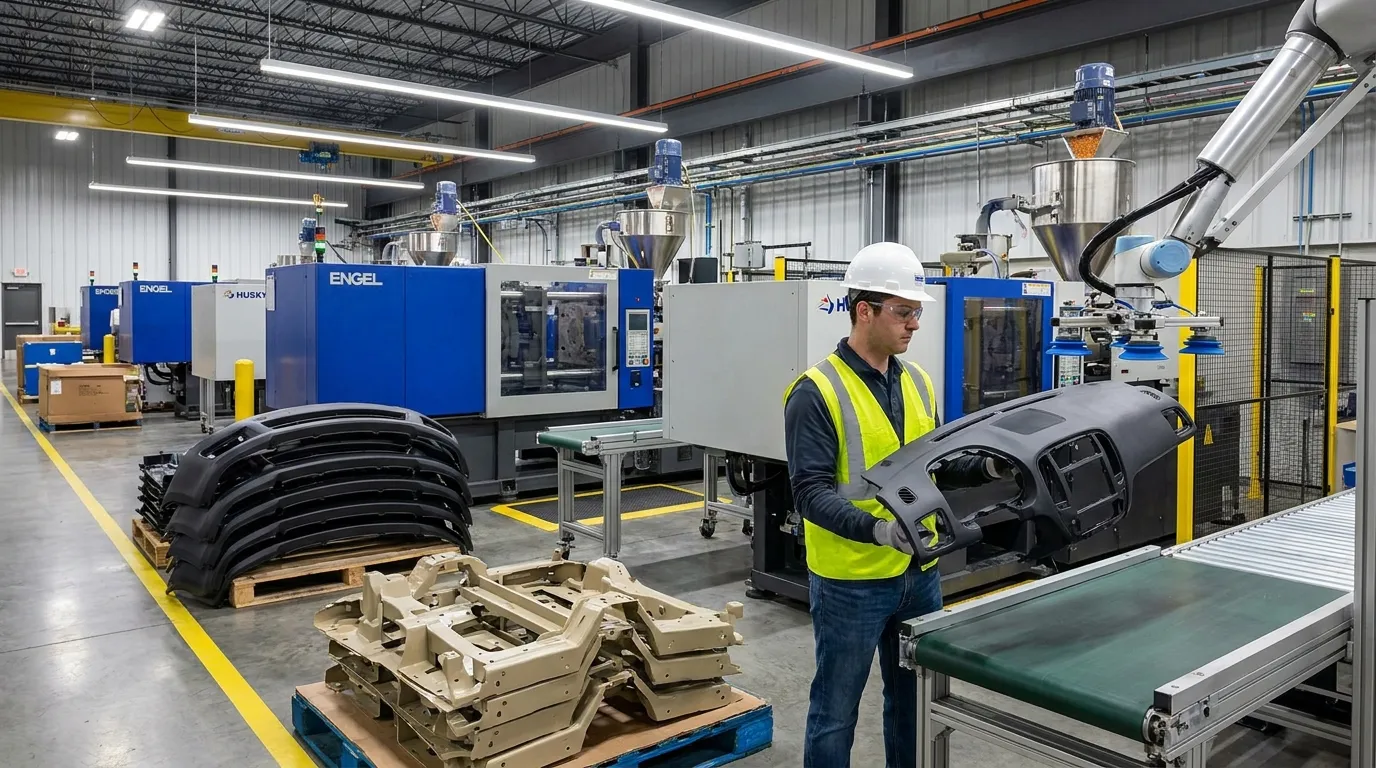
Automotive plastic molding uses injection molds to mass-produce precise vehicle components with repeatable quality. It is widely used for dashboards, バンパー, 住宅, トリム, and structural support parts because it supports complex geometries, lightweighting, and scalable production.
Automotive injection molding works by forcing molten plastic into a precision mold cavity under pressure. 冷却後, the part ejects with consistent dimensions and repeatable geometry. This process supports high-volume production with tight tolerances, which is essential for vehicle manufacturing.
Car manufacturers use molded plastics because they reduce weight and support complex part designs that would be difficult or expensive with metal. それによると アメリカ合衆国. Environmental Protection Agency, plastics are widely used across transportation applications because they balance durability, 柔軟性, and manufacturing efficiency.
内装トリム, exterior panels, クリップ, 住宅, and structural supports all use different tooling strategies. Companies sourcing 自動車成形ソリューション often focus on repeatability, 表面品質, and production scalability before anything else.
一般的に射出成形されている自動車部品はどれか?
Automotive injection molding is commonly used for dashboards, door panels, bumper covers, グリル, battery housings, クリップ, 括弧, and engine-compartment components. Different part categories require different materials, mold tolerances, cooling strategies, and surface finishes.
Automotive parts usually fall into three main categories: interior, exterior, and structural components. Each category places different demands on mold engineering, 樹脂選抜, and production control.
| 部品カテゴリ | 共通点 | 主な優先事項 | 典型的な材料 | 工具の複雑さ |
|---|---|---|---|---|
| 内部 | ダッシュボード, consoles, door panels | 外観の品質 | ABS, PP blends | メディア |
| 外観 | Bumpers, グリル, ミラーハウジング | 紫外線および衝撃耐性 | PP, PCブレンド | 中〜高 |
| 構造 | Battery housings, 括弧, supports | 強度と次元安定性 | ガラス充填ナイロン | ハイ |
Interior parts focus heavily on appearance. Exterior components must survive heat, 水分, road debris, and sunlight. Structural parts handle mechanical loads and often require reinforced materials.
多くの製造業者が製造しています 成形自動車部品 separate tooling strategies based on these application groups early in the DFM process. That helps reduce costly redesigns later in production.
How do interior automotive parts affect mold design?
Interior automotive molds prioritize cosmetic consistency, texture accuracy, および次元安定性. ダッシュボードパネル, trim pieces, and console components require tight surface-quality control because visible defects immediately affect perceived vehicle quality.
Interior parts may not handle structural loads, but they often create the highest cosmetic expectations. A small weld line or sink mark on a dashboard panel can become immediately visible to vehicle buyers. That changes how tooling engineers design gates, 冷却システム, and surface textures.
Dashboard molds, 例えば, often require highly controlled cooling to reduce warpage across large flat surfaces. Interior trim pieces also need consistent texture replication. Uneven gloss levels or inconsistent grain patterns can make production parts look mismatched inside the vehicle cabin.
自動車内装における一般的な外観欠陥
- リブや取り付けポイント付近の沈み跡
- 開口部の周囲に見える溶接線
- ロングトリム部品の歪み
- テクスチャー面間での光沢の不均一性
- スナップフィット機能のフラッシュアラウンド
Cosmetic automotive parts are usually harder to perfect than many structural parts. Structural components can tolerate minor visual variation, but interior trim cannot. That’s why mold polishing, 換気, and cooling balance become major priorities during tooling development.
A textured dashboard mold and a painted bumper mold illustrate this difference clearly. The dashboard tool focuses on texture consistency and low distortion, while the bumper mold focuses more on impact resistance and dimensional stability during assembly.
より深い工具の基礎を知りたい読者へ, これだ 射出成形設計の基本 resource explains broader mold engineering concepts in more detail.
What changes for exterior automotive plastic parts?
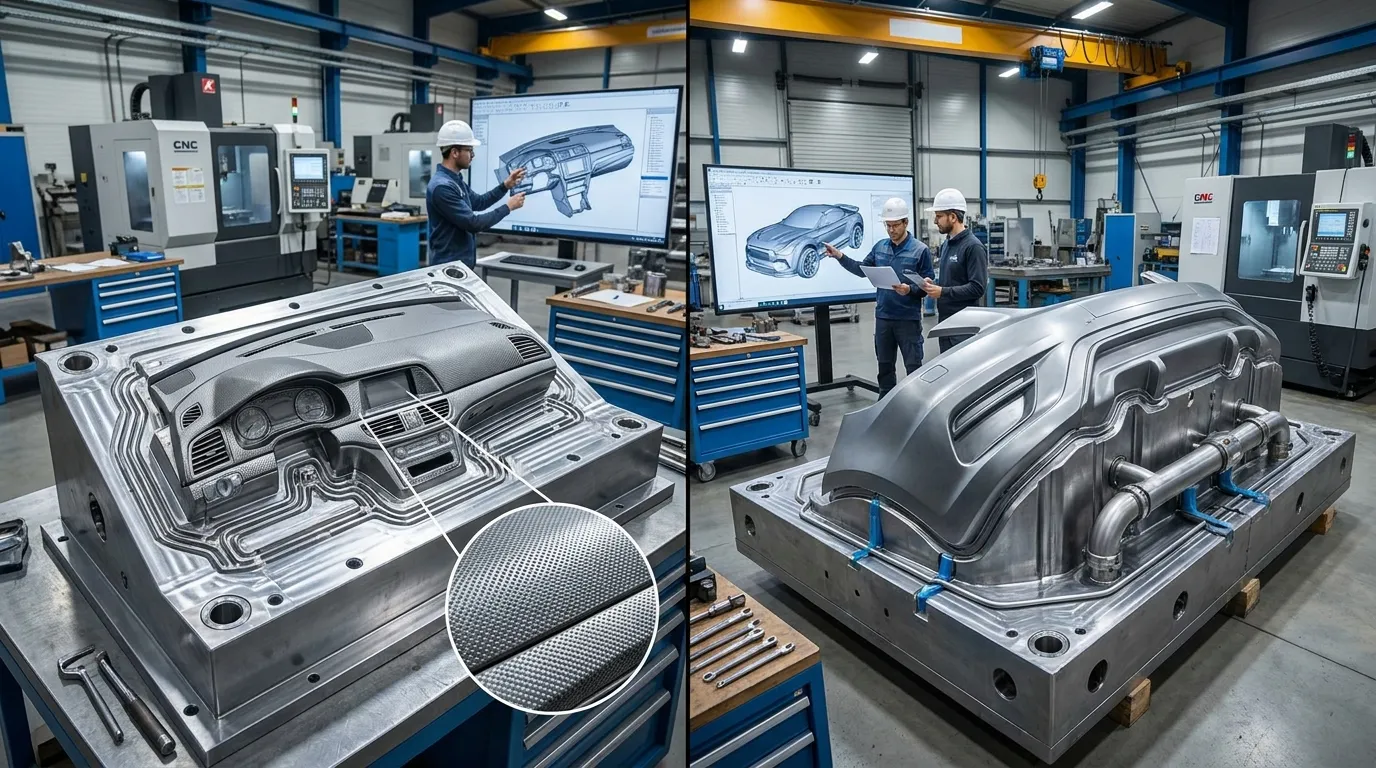
Exterior automotive parts require molds that support durable finishes, impact-resistant materials, and stable dimensions under heat and UV exposure. Bumpers, グリル, and mirror housings often require larger tooling systems and stricter process consistency.
Exterior automotive parts deal with far harsher environments than interior components. 熱, 水分, sunlight, road debris, and temperature swings all affect material selection and tooling requirements. Molds for these parts must support stable processing over long production runs.
Large exterior components also create cooling challenges. A bumper cover, 例えば, requires balanced cooling across a wide mold surface to reduce distortion. Poor cooling balance can create uneven shrinkage and assembly problems during vehicle production.
バンパーモールドがダッシュボードモールドと異なる理由
| バンパーモールド優先 | ダッシュボードの金型優先 |
|---|---|
| 耐衝撃性 | 表面のテクスチャ一貫性 |
| 紫外線耐性 | 外観上の粒状精度 |
| 塗料の接着 | 低光沢の変異 |
| 大部次元安定性 | タイトで見えるフィットライン |
Exterior molds also require attention to paintability and surface durability. Some exterior parts use textured finishes, while others require Class A surfaces that support high-quality painting.
Lower tooling quotes are not always cheaper long term. Exterior molds with weak cooling systems or lower-grade steel may struggle with large-part consistency after extended production cycles. That often leads to higher maintenance costs and slower production later.
チームの調達 自動車用射出成形プロセス support often evaluate tooling durability alongside upfront cost for this reason.
How do mold requirements change for structural automotive parts?
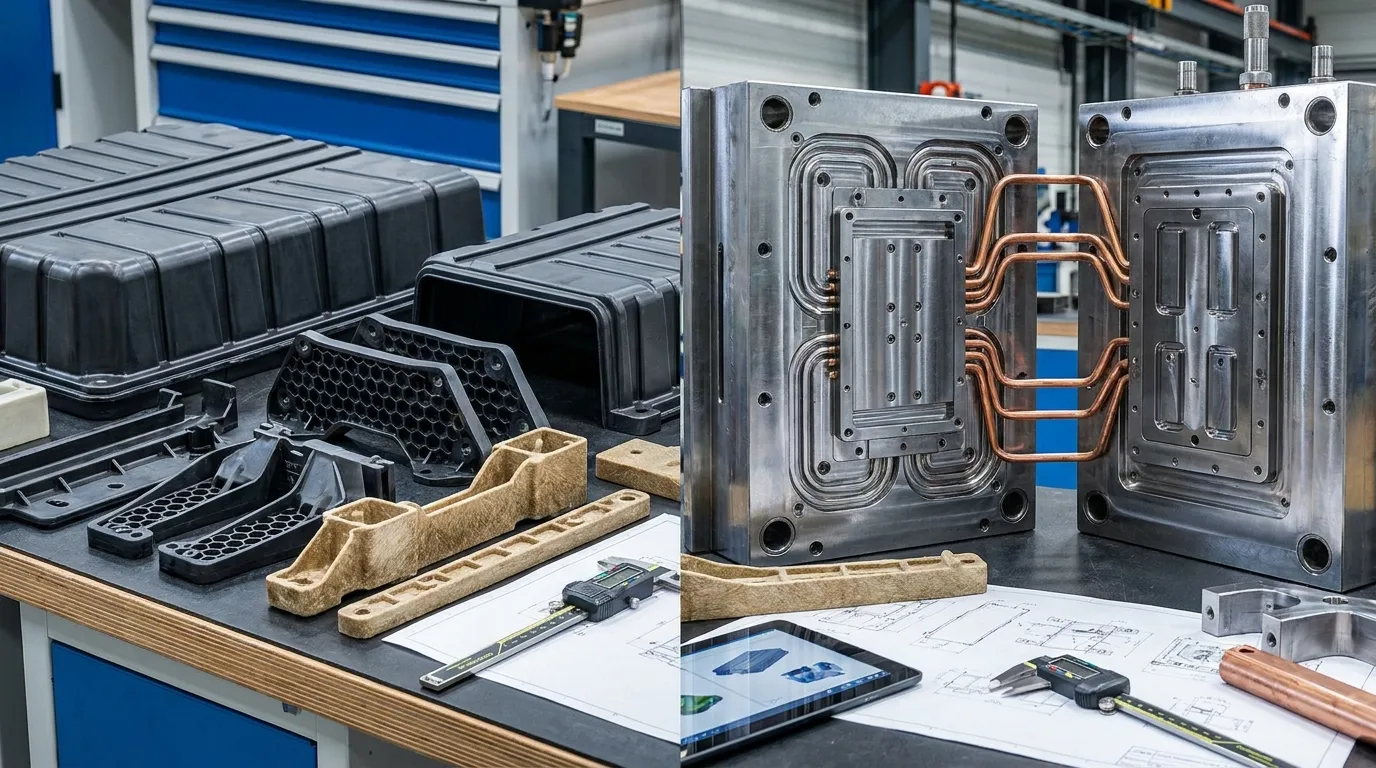
Structural automotive plastic parts require stronger materials, tighter engineering validation, and more durable tooling than cosmetic components. Battery housings, 括弧, and under-hood supports must maintain strength, 次元安定性, and long-term performance under stress.
Structural parts create different engineering priorities because they carry loads or support critical assemblies. These parts often use reinforced engineering plastics that increase mold wear and processing complexity.
Glass-filled nylon is a common example. It improves stiffness and heat resistance, but the abrasive glass fibers wear mold surfaces faster than standard polypropylene. Buyers focused only on part strength sometimes underestimate how quickly reinforced materials can increase tooling maintenance requirements.
構造自動車部品に一般的に使われる材料
| 構造的要件 | 共通素材 | 工具の影響 |
|---|---|---|
| 耐熱性 | ガラス充填ナイロン | 金型摩耗の増加 |
| Dimensional stability | PCブレンド | 厳密な冷却制御 |
| 衝撃強度 | 強化PP | より大きなゲート要件 |
| 電気絶縁 | 熱可塑性樹脂工学 | 精密公差制御 |
EV battery housings are a good example of structural complexity. These components require dimensional stability across large surfaces because small variations can affect sealing performance or assembly alignment.
Snap-fit console clips and large structural battery supports also show very different tooling demands. The clip mold may focus on tiny tolerance control and fast cycles, while the battery housing mold may prioritize cooling efficiency and long-term dimensional stability across a much larger cavity.
多くのエンジニアリングチームは complete mold component guide when evaluating tooling durability, 冷却システム, and cavity design for reinforced materials.
Which plastics are commonly used for automotive parts?
Automotive manufacturers choose plastics based on heat resistance, 衝撃強度, 紫外線曝露, 化学耐性, そして見た目の要件. Polypropylene, ABS, ナイロン, and reinforced engineering plastics are commonly selected for different automotive applications.
Material selection changes based on where the part sits in the vehicle and what conditions it must survive. Interior trim parts may prioritize appearance and low cost, while under-hood parts require heat resistance and structural strength.
| 素材 | 一般的な自動車用途 | 主な利点 |
|---|---|---|
| Polypropylene (PP) | Bumpers, トリム, panels | 軽量でコスト効率も良い |
| ABS | ダッシュボード, interior trim | 見た目も良いです |
| ポリカーボネートブレンド | 外装住宅 | 耐衝撃性 |
| ナイロン (PA) | 構造ブラケット | 強度と耐熱性 |
| ガラス充填ナイロン | フード下の支柱 | 高剛性 |
次の通りです プラスチックス・ヨーロッパ, engineering plastics help reduce vehicle weight while supporting durability and manufacturing efficiency.
Glass-filled materials are not always the safest choice. They work well for high-strength applications, but they also accelerate mold wear significantly. For some medium-load parts, reinforced polypropylene may provide a better balance between tooling life and mechanical performance.
What production problems commonly affect automotive molded parts?
Automotive molded parts often fail because of cooling imbalance, 収縮変動, poor venting, or inconsistent process control. Even small dimensional shifts can create assembly issues when parts must align with surrounding vehicle components.
Warpage is especially common in large parts like door panels and bumper covers. Uneven cooling rates across the mold cavity can cause twisting or dimensional distortion after ejection. Sink marks also appear frequently around ribs and thicker wall sections.
なぜ自動車の公差が欠陥リスクを高めるのか
- 長部部品の歪み
- 構造リブ近くの陥没痕
- 遮断エリア周辺のフラッシュ
- 開口部周辺の溶接線
- 空洞間の収縮不均一
Automotive tolerances increase risk because molded parts often interact with metal fasteners, electronic assemblies, or visible body gaps. Small dimensional changes can affect fit, 外見, or assembly speed.
A supplier choosing lower-cost cooling layouts may reduce upfront tooling expenses, but poor cooling balance often creates higher rejection rates later. 次の通りです この欠陥分類研究, production defects remain a major focus area for automated quality inspection systems.
繰り返し発生する品質問題を評価する読者 自動車成形の欠陥 often focus on cooling consistency, resin control, and cavity balance first.
How should buyers evaluate an automotive molding supplier?
Buyers should evaluate automotive molding suppliers based on tooling engineering capability, automotive quality systems, material expertise, 生産のスケーラビリティ, and communication transparency. The lowest tooling quote is not always the safest long-term manufacturing decision.
Automotive tooling projects involve more than part pricing. Buyers should evaluate whether the supplier understands production consistency, カビのメンテナンス, reinforced materials, and automotive dimensional requirements before approving tooling.
Lead time transparency also matters. 次の通りです アプリオス・インサイト, tooling complexity can significantly affect production timelines. Structural molds with large cavities or reinforced materials usually require more engineering validation and testing.
自動車のカビ決定チェックリスト
| 評価エリア | 購入者が確認すべきポイント |
|---|---|
| 自動車業界での経験 | 過去の自動車生産プログラム |
| 物質的専門知識 | 強化エンジニアリングプラスチックの経験 |
| 工具の品質 | Steel selection, 冷却設計, メンテナンス計画 |
| 生産のスケーラビリティ | ボリューム増加を支える能力 |
| 通信 | DFMフィードバックとタイムラインの明確さ |
| 品質システム | 検査プロセスと寸法制御 |
Nearshoring and mold transfer flexibility are becoming more important for automotive sourcing teams. Fictivの製造動向レポート highlights growing pressure around supply chain resilience and tooling adaptability.
より広範な企業 精密製造の経験 often bring stronger process discipline to automotive programs, especially for high-tolerance components.
次のステップを正しく進める
Automotive plastic molding works best when tooling strategy matches the part’s real application requirements. Cosmetic interior panels, exterior body parts, and structural supports all demand different engineering priorities, material choices, and production controls.
If you’re sourcing automotive molds, focus on long-term production stability instead of only upfront tooling cost. 冷却バランス, material compatibility, dimensional control, and mold durability usually affect total manufacturing cost far more than the initial quote. A supplier that understands those tradeoffs can help prevent expensive quality and maintenance problems later.
よくある質問
What plastics are used in automotive injection molding?
Automotive injection molding commonly uses polypropylene, ABS, ナイロン, polycarbonate blends, およびガラス充填エンジニアリングプラスチック. 材料の選択は熱への曝露に依存します, 外観の要件, structural load, 紫外線耐性, そして長期的な耐久性.
What automotive parts are injection molded?
Many dashboards, バンパー, グリル, door panels, battery housings, クリップ, 括弧, and interior trim components are injection molded. The process supports high-volume production with consistent dimensions and repeatable quality.
What is the best plastic for automotive exterior parts?
Exterior automotive parts often use polypropylene blends, ABS blends, or reinforced engineering plastics because they resist UV exposure, 熱, 水分, and impact damage. The best material depends on the part’s mechanical and cosmetic requirements.
How durable are automotive plastic parts?
Automotive plastic parts can last for years when the correct resin, tooling design, and processing controls are used. Structural and under-hood components typically require reinforced materials and stricter validation testing.
自動車用射出成形はどのくらい持ちますか?
Automotive injection molds can last hundreds of thousands or even millions of cycles depending on steel quality, 材料の研磨性, and maintenance practices. Structural and glass-filled applications usually create faster mold wear.
Why is plastic used in modern vehicles?
Plastics help reduce vehicle weight, support complex geometries, improve fuel efficiency, and lower manufacturing costs compared with many metal alternatives. They also allow faster high-volume production.



サンシャインより書かれました
サンシャインで, 私たちは精密金型部品の専門製造およびサプライヤーです, プレスおよび射出成形用途向けの幅広い製品を提供しています. 私たちの主な焦点はパンチダイスです, イジェクターピンとスリーブ, ガイドポストとブッシング. 高度なCNC加工技術で, 厳格な品質管理, そして強力な生産能力, 私たちは信頼性を保証しています, 高精度部品, また、迅速かつ効率的なグローバル供給のための在庫の標準部品も併用しています.
ニュース
サービスを受けましょう
あらゆる予算に合った高品質な部品と、親切なスタッフが訓練されていて、訪問を有益で手間なく充実させてくれます.
