



金型部品の熱処理: 硬度, 耐摩耗性, そしてツールライフ
Heat treatment for mold parts improves hardness, 耐摩耗性, and tool life by changing the steel structure and stabilizing high-friction surfaces. Processes like quenching, tempering, and nitriding help ejector pins, パンチ, 案内標, and sleeves resist wear, ひび割れ, および変形. The right treatment depends on the mold component, cycle volume, operating stress, and dimensional tolerance requirements.
Mold components fail faster when heat treatment doesn't match the material or production environment. A punch may crack because it's too hard. A guide bushing may lose alignment because it distorted during quenching. Choosing the right process helps reduce maintenance, improve cycle consistency, and extend mold life without increasing unnecessary tooling costs.
What does heat treatment do for mold parts?
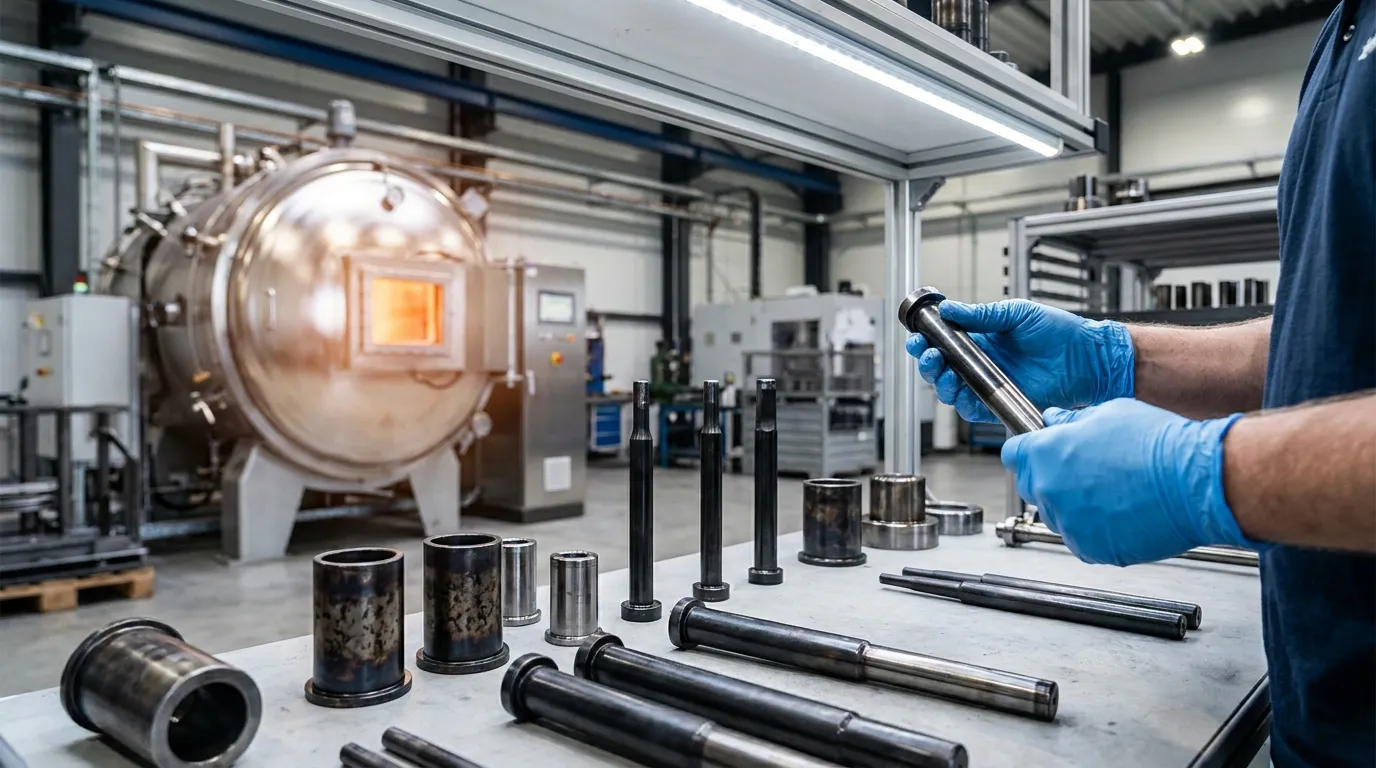
Heat treatment for mold parts improves hardness, 耐摩耗性, and dimensional stability by changing the steel microstructure. Proper treatment extends mold life and reduces maintenance, but excessive hardness can increase cracking risk.
Heat treatment controls how mold steel responds to stress, 摩擦, and repeated production cycles. During processes such as quenching and tempering, the steel is heated and cooled under controlled conditions. This changes the internal grain structure and improves the part's mechanical properties.
In injection molds, high-contact components experience constant pressure and sliding movement. Ejector pins push parts out thousands of times per day. Guide posts absorb alignment stress during every cycle. Without proper heat treatment, these surfaces wear quickly and lose dimensional accuracy.
次の通りです 真空熱処理の指導, stress relief and controlled heating help reduce internal defects and improve stability. That matters because even small dimensional changes can affect mold alignment and surface quality.
Higher hardness is not always better. Some mold parts fail earlier because they become too brittle after aggressive hardening. In many production environments, balanced toughness and wear resistance perform better than maximum hardness alone.
| 熱処理目標 | 生産上のメリット |
|---|---|
| 硬度を上げる | 耐摩耗性の向上 |
| 靭性の向上 | 亀裂リスクの低減 |
| ストレスを軽減しましょう | より良い次元安定性 |
| 硬化面 | 部品寿命の延長 |
| 構造を安定化させる | 一貫した制作精度 |
より広い視点で完全な情報を得るために injection mold components, it's important to understand how each part handles different loads and wear conditions.
Which mold components benefit most from heat treatment?
High-friction mold components such as ejector pins, パンチ, 案内標, and sleeves benefit most from heat treatment because they face repeated wear, 圧力, and alignment stress during high-cycle production.
Not every mold part requires the same treatment level. Structural plates may only need moderate hardness, while moving components often need stronger surface protection. The highest wear usually appears where metal-to-metal contact repeats continuously.
A high-cycle automotive mold is a good example. If ejector pins are too soft, the pin heads wear unevenly and start sticking inside the mold. That creates ejection problems, longer cycle times, and more maintenance shutdowns.
| カビ構成要素 | 主なストレスタイプ | 推奨焦点 |
|---|---|---|
| イジェクターピン | スライド着用 | 表面硬度 |
| パンチ | 衝撃と圧力 | 靭性硬度 |
| ガイドブッシング | アライメント摩擦 | 耐摩耗性 |
| スリーブ | 繰り返し運動 | 表面安定性 |
| 型芯 | 熱と圧力 | Dimensional stability |
Guide parts deserve special attention because alignment problems spread across the entire mold system. A distorted guide bushing can shift cavity positioning and increase flash defects. This is one reason heat treatment is closely tied to the overall 型製造工程.
Medical molding applications often use nitrided sleeves because the process creates a hard outer layer without causing large dimensional changes. That helps maintain polished surfaces and consistent cavity performance over long production runs.
What hardness range is best for different mold parts?
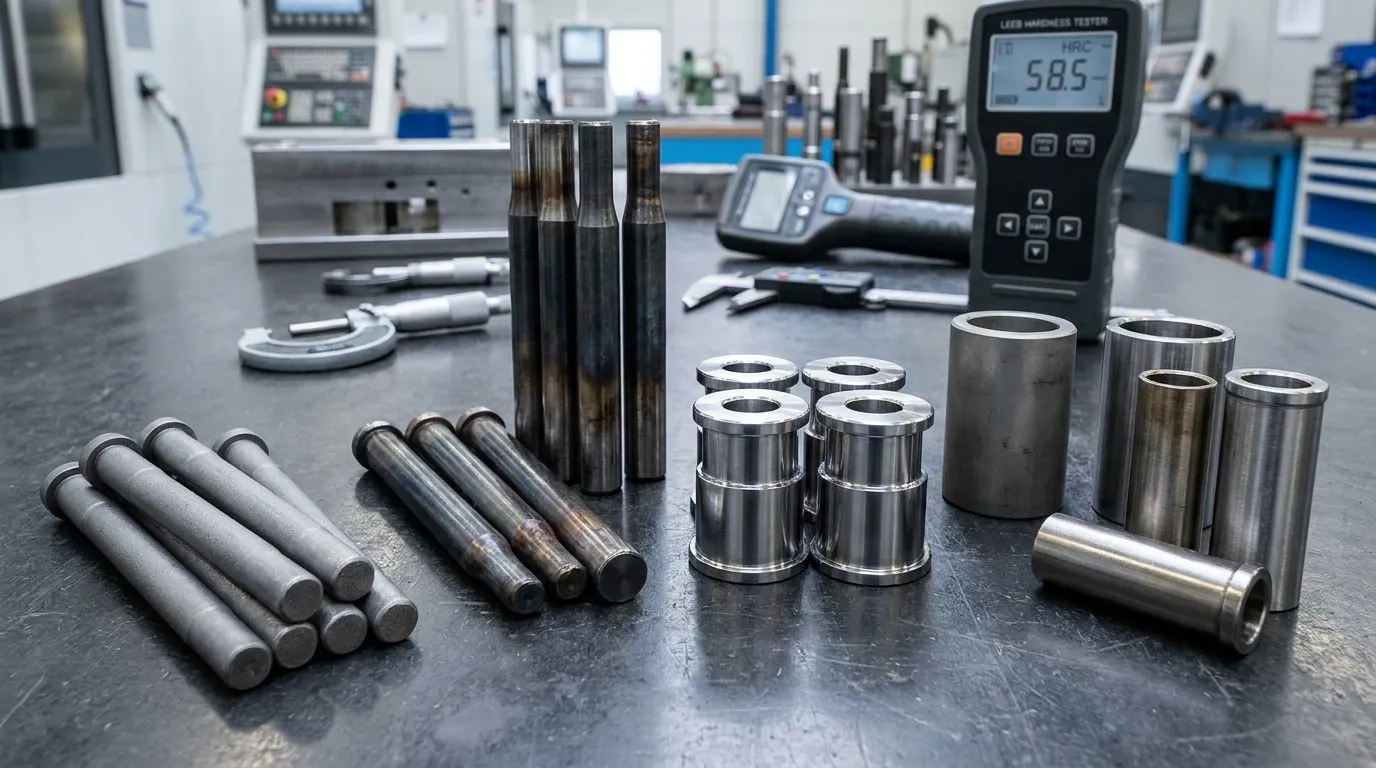
The best hardness level depends on the component function. High-wear parts often require higher hardness, while alignment and structural parts need more toughness to avoid cracking or deformation.
Many buyers assume harder mold parts automatically last longer. That isn't always true. A punch with excessive hardness may crack under repeated impact, especially in fast-cycle production. A slightly lower hardness range can improve toughness and extend usable service life.
The right balance depends on friction, impact load, thermal stress, and dimensional requirements. High-wear surfaces usually benefit from harder outer layers, while structural parts often need flexibility to absorb stress safely.
型部品熱処理決定表
| 構成要素 | 推奨硬度 | 優先治療 | 主な故障リスク | 最適アプリケーション |
|---|---|---|---|---|
| Ejector pin | HRC 58-62 | 窒化 | Surface wear | ハイサイクル型 |
| Punch | HRC 56-60 | 焼入れテンパー | ひび割れ | 繰り返される影響 |
| Guide bushing | HRC 50-56 | 硬化を通じて | 歪み | アライメントシステム |
| Sleeve | HRC 58-60 | 窒化 | 苛立たしい | 精密金型 |
| 型芯 | HRC 48-54 | 真空熱処理 | 熱疲労 | 複雑な空洞 |
次の通りです 真空熱処理プロセスの指導, controlled cooling improves dimensional stability and reduces distortion risk. That's especially important for precision molds with tight tolerances.
A guide bushing that warps during quenching may still appear usable, but slight alignment changes can create uneven wear across the mold. 時間をかけて, that increases maintenance costs and reduces production consistency.
When should you use nitriding instead of through hardening?
Nitriding is often preferred for mold components that need high surface wear resistance with minimal distortion. Through hardening works better when uniform hardness is needed throughout the part.
The main difference is where the hardness is created. Through hardening affects the full thickness of the steel, while nitriding mainly hardens the outer surface. That makes nitriding useful for precision parts that must keep tight dimensional tolerances.
Nitriding also produces less deformation because it operates at lower temperatures than many quenching processes. In molds with polished sleeves or precision ejector systems, reduced distortion can improve long-term performance.
イジェクターピンにおける窒化の利点
Ejector pins slide constantly during production. Nitriding creates a hard wear-resistant surface that reduces friction and slows surface damage. This helps prevent sticking and uneven wear patterns in high-cycle molds.
A nitrided sleeve used in medical molding may maintain surface quality much longer than a conventionally hardened sleeve. That matters when cavity finish directly affects cosmetic appearance or sealing performance.
硬化がより安全な場合
Through hardening works better when the entire component must resist heavy mechanical load. Large punches and structural mold parts often need consistent hardness across the full section to avoid internal weakness.
Nitriding is not always the best choice. It works well for surface wear, but deeper impact loads may still damage softer internal material. そういう場合, through hardening provides more reliable structural support.
これらの方法の選択は、金型の操作条件や全体的な条件に合ったものであるべきです 型設計ガイドライン. A process that performs well for guide sleeves may not work for impact-heavy punches.
How does poor heat treatment shorten mold life?
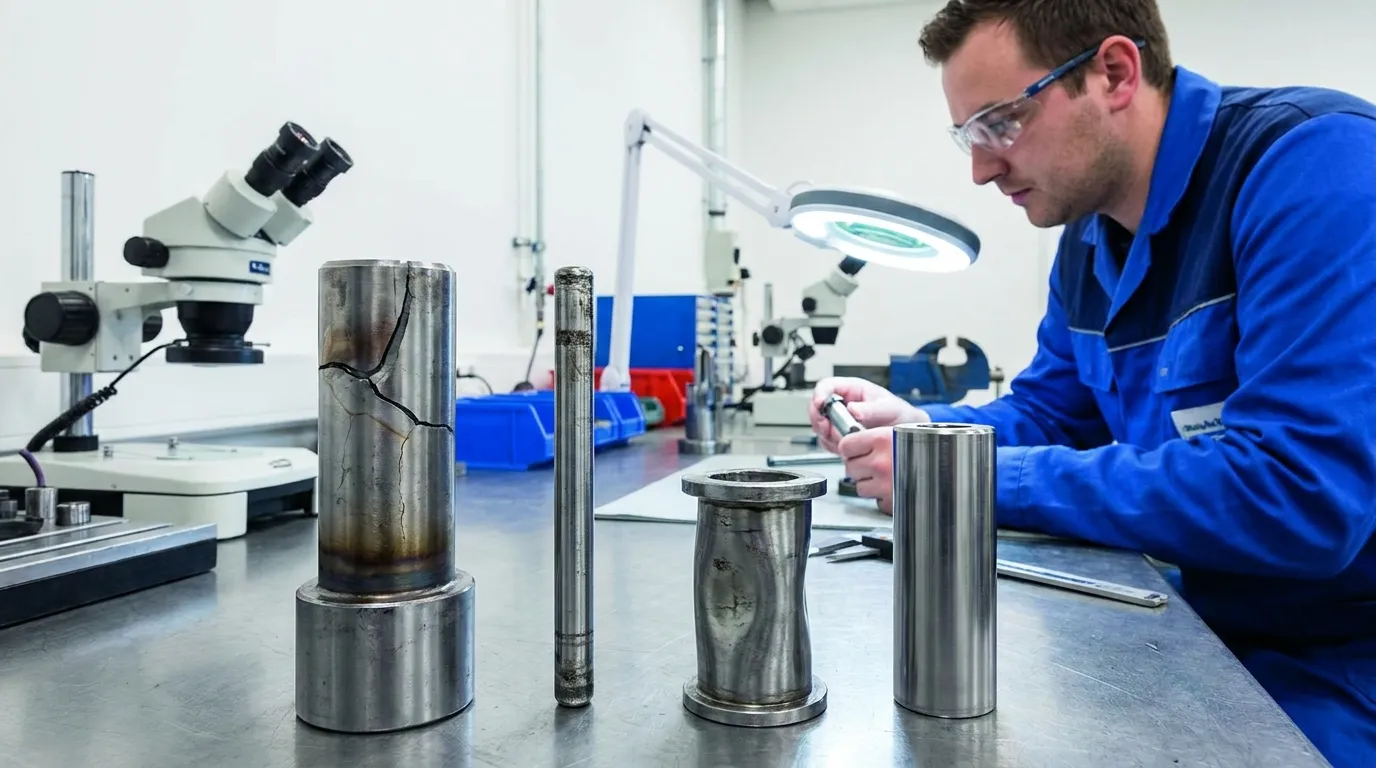
Poor heat treatment can shorten mold life by causing internal stress, ひび割れ, distortion, and unstable hardness. Many failures happen because the treatment process does not match the mold steel or operating conditions.
Heat treatment problems often appear slowly at first. A component may pass inspection but fail early during production because the internal structure isn't stable. 不均一な冷却, excessive hardness, or poor stress relief are common causes.
One common failure involves over-hardened punches. In repeated stamping or molding cycles, the punch becomes brittle and develops surface cracks near high-stress corners. Once cracking starts, replacement usually becomes unavoidable.
熱処理失敗の一般的な兆候
- 端や角の表面亀裂
- 可動部品の摩耗パターンの不均一さ
- 歪みが金型のアライメントに影響を与える
- 研磨安定性の低下
- 早期のむきむきや粘着
次の通りです 熱処理プロセスの指導, cold treatment and stress reduction can help improve dimensional stability. Preventing distortion is especially important for guide systems and precision cavities.
Many mold failures blamed on poor steel quality are actually caused by incorrect cooling or uncontrolled heat treatment parameters. A guide bushing that loses alignment after quenching can create flash defects across the entire mold system, increasing long-term カビ交換費用.
熱処理失敗チェックリスト
| 症状 | 原因としては | 推奨修正案 | 制作への影響 |
|---|---|---|---|
| 表面亀裂 | 過剰な硬度 | 低硬度ターゲット | 予期せぬダウンタイム |
| 歪み | 不均一な冷却 | 制御式焼入れ | アライメントの問題 |
| 急速な摩耗 | 低い表面硬度 | 表面硬化 | 頻繁なメンテナンス |
| 苛立たしい | 表面仕上げの悪さ | 窒化または研磨 | 排出問題 |
| 弱点 | 不均一な加熱 | プロセス制御のレビュー | 工具寿命の短縮 |
How does heat treatment affect surface finish and maintenance?
Heat treatment directly affects friction, polishing stability, and long-term maintenance intervals. Poorly treated surfaces wear unevenly, lose polish quality faster, and create more production interruptions.
Mold surfaces with stable hardness usually maintain finish quality longer during high-cycle production. That becomes important in cosmetic molding applications where surface scratches or wear marks transfer directly onto the plastic part.
A properly nitrided sleeve may require fewer polishing cycles because the hardened surface resists abrasion better. Untreated or unstable surfaces often lose smoothness faster and increase drag during ejection.
Heat treatment also affects maintenance planning. Components with balanced hardness and toughness generally last longer between inspections, especially in molds running abrasive resins or continuous production schedules.
For molds where appearance matters, surface durability should align with the required 型の表面品質. Heat treatment and polishing performance work together, especially in precision molding environments.
What should buyers ask before ordering heat-treated mold components?
Buyers should verify hardness range, steel grade, heat treatment method, and dimensional tolerance before ordering mold components. These details directly affect wear resistance, maintenance frequency, and production stability.
Many sourcing problems start because the treatment process isn't clearly specified. Two components may use the same steel grade but perform very differently depending on how they were hardened and tempered.
生産承認前のことです, buyers should confirm:
- 目標硬度範囲
- 使用される熱処理方法
- 表面処理深度
- 処理後の寸法公差
- 硬度検査または認証の利用可能性
A supplier should also explain whether the component uses nitriding, through hardening, vacuum treatment, or another process. That information matters because different methods affect distortion risk and maintenance intervals differently.
例えば, a high-cycle ejector system may need nitrided pins with controlled surface hardness, while a large structural punch may require deeper through hardening for impact resistance. Matching the process to the real production load helps prevent early failures and replacement costs.
次のステップを正しく進める
Heat treatment for mold parts affects much more than hardness. It influences wear resistance, alignment stability, maintenance frequency, and long-term production consistency. A component that looks acceptable on paper may still fail early if the treatment process doesn't match the operating conditions.
The safest approach is to evaluate each mold component separately. イジェクターピン, ガイドブッシング, パンチ, and sleeves all handle stress differently. Choosing the right heat treatment for mold applications helps reduce downtime, extend tool life, and maintain stable molding performance over high production volumes.
よくある質問
What is heat treatment in mold manufacturing?
Heat treatment changes the mechanical properties of mold steel through controlled heating and cooling. It improves hardness, 耐摩耗性, and dimensional stability so mold parts can handle repeated production cycles with less wear.
Does higher hardness always improve mold life?
Higher hardness does not always mean longer mold life. Excessive hardness can make mold components brittle and more likely to crack under impact or thermal stress during production.
What is nitriding in mold manufacturing?
Nitriding creates a hard wear-resistant surface layer by adding nitrogen to the steel surface. It's commonly used when mold parts need better wear resistance with minimal dimensional distortion.
Which mold parts usually require heat treatment?
High-wear mold components usually require heat treatment. イジェクターピン, パンチ, 案内標, sleeves, and wear surfaces face repeated friction and pressure during molding cycles.
What causes mold cracking after heat treatment?
Improper heat treatment can create internal stress that leads to cracking. 過剰な硬度, uneven cooling, poor material selection, and uncontrolled quenching are common causes.
How does heat treatment affect mold maintenance?
Correct heat treatment reduces maintenance requirements by improving wear resistance and dimensional stability. Mold components stay functional longer and need fewer replacements during high-cycle production.



サンシャインより書かれました
サンシャインで, 私たちは精密金型部品の専門製造およびサプライヤーです, プレスおよび射出成形用途向けの幅広い製品を提供しています. 私たちの主な焦点はパンチダイスです, イジェクターピンとスリーブ, ガイドポストとブッシング. 高度なCNC加工技術で, 厳格な品質管理, そして強力な生産能力, 私たちは信頼性を保証しています, 高精度部品, また、迅速かつ効率的なグローバル供給のための在庫の標準部品も併用しています.
ニュース
サービスを受けましょう
あらゆる予算に合った高品質な部品と、親切なスタッフが訓練されていて、訪問を有益で手間なく充実させてくれます.
