



プラスチック射出成形部品: 標準部品購入者が知っておくべき
Plastic injection mold components include the core, 空洞, runner system, 冷却チャネル, 排出システム, vents, and alignment parts that control part quality and mold performance. Buyers should focus on component precision, 耐摩耗性, 冷却効率, and maintenance accessibility because these factors directly affect mold lifespan, ダウンタイム, 欠陥率, and long-term tooling cost.
A mold can look well-built from the outside and still create expensive production problems. Most tooling issues start with component quality, アライメント, 冷却バランス, or wear resistance. 新しいカビを調達する場合, understanding how each component affects maintenance and production stability helps you avoid downtime, rejected parts, and early tooling replacement. This guide breaks down the standard parts buyers should evaluate before approving a mold build.
What are the main plastic injection mold components?
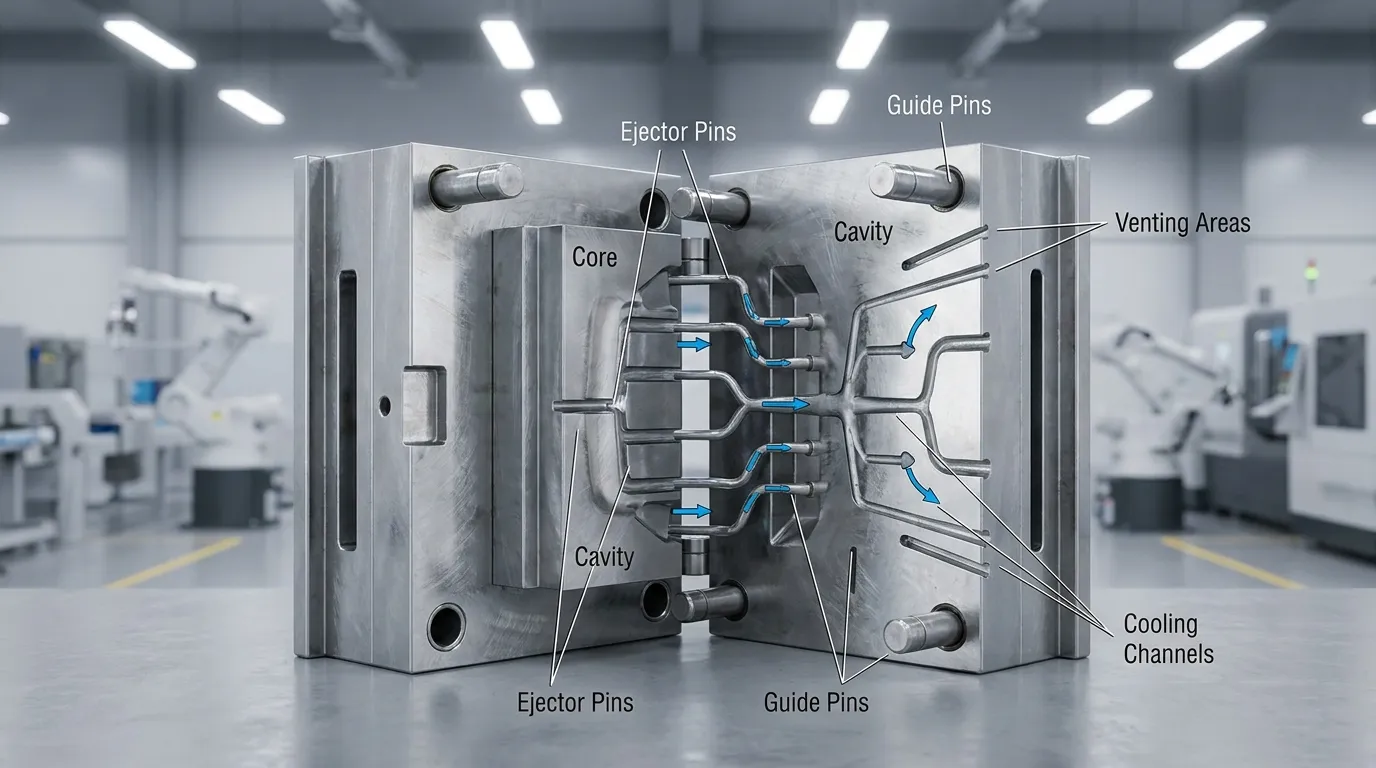
Plastic injection mold components include the mold base, コアとキャビティ, runner system, 排出システム, 冷却チャネル, vents, and alignment parts. Each component affects part quality, サイクルタイム, メンテナンス頻度, and overall mold lifespan.
Most injection molds use the same core systems, even when the finished products are very different. The mold base supports the structure, while the core and cavity shape the plastic part itself. The runner system moves molten plastic into the cavity, and the ejector system pushes the finished part out after cooling.
Cooling channels remove heat during production. Venting systems release trapped air that could otherwise create burn marks or incomplete filling. Guide pins and bushings keep both mold halves aligned during every cycle.
If you need a broader overview of how these systems fit together, サンシャイン・プロの 完全な金型部品ガイド explains the full mold structure and production workflow.
プラスチック部分を形作る部品
The core and cavity are the most critical shaping components. Their machining accuracy directly affects dimensions, 表面仕上げ, および部品の整合性. Gates and runners also influence filling pressure and material flow.
次の通りです ファーストモールドの射出成形部品ガイド, these systems work together to control how material enters and forms inside the mold.
Components that control cooling, 射出, and alignment
Cooling channels manage temperature during production. Ejector pins remove the finished part after solidification. Guide pins and bushings maintain alignment between moving mold halves.
もっと詳しく調べてみるといいです 金型コンポーネントシステム if you're comparing tooling configurations across suppliers.
| 構成要素 | 主な機能 | 買い手の懸念 |
|---|---|---|
| コアとキャビティ | 製品の形状を作ろう | 耐摩耗性 |
| ランナーシステム | 溶けたプラスチックを届けろ | 流量バランス |
| 冷却チャネル | 熱を取り除く | サイクルの一貫性 |
| イジェクターピン | 完成品のリリース | 摩耗頻度 |
| ガイドピン | アライメントを維持 | 長期精度 |
| 換気システム | 閉じ込められた空気を放出する | 欠陥防止 |
Which mold components affect mold life and part quality the most?
Core and cavity precision, 冷却効率, venting quality, and guide alignment have the biggest impact on mold life and part consistency. Poor-quality components increase flash, ショートショット, 使用期間, and unplanned maintenance.
Not every mold component deserves the same level of investment. Buyers should prioritize the systems that directly affect dimensional accuracy, heat control, and repeated mechanical movement.
The core and cavity usually see the highest pressure and repeated thermal cycling. Poor steel quality or weak machining tolerance in these areas can shorten mold life quickly. Even small alignment errors may lead to flash defects, 不均一な摩耗, or part inconsistency.
Cooling design also has a bigger impact than many buyers expect. A mold with balanced cooling often performs better over time than one with expensive cosmetic finishes but weak thermal control. That matters in high-volume production where cycle stability affects output every day.
RapidDirectの金型成分分解 highlights how cooling, 換気, and alignment systems affect molding stability and defect prevention.
| 構成分野 | 制作への影響 | 共通リスク |
|---|---|---|
| コアとキャビティ | 部品寸法 | 早期摩耗 |
| 冷却チャネル | サイクルの一貫性 | ワープ |
| 換気システム | エアリリース | 焼け跡 |
| ガイドピン | アライメント | フラッシュ欠陥 |
| エジェクターシステム | パートリリース | 固着や損傷 |
Cheap wear components often create more long-term downtime than buyers expect. Saving money on guide systems or ejector hardware may reduce upfront tooling cost, but recurring maintenance usually costs far more during production.
If you're evaluating higher-grade tooling systems, サンシャイン・プロの 精密金型部品 page covers common precision component configurations.
What does each major mold component actually do?
Every major mold component controls a specific production task. Some manage material flow, while others handle cooling, アライメント, or part release after molding.
給料およびランナー部品
The runner system moves molten plastic from the injection machine into the mold cavity. Gates control how material enters the cavity and affect filling speed, 圧力, および表面仕上げ.
Sprue bushings connect the machine nozzle to the runner system. Poor gate or runner design can create uneven filling, 空気が閉じ込められている, or cosmetic defects.
冷却, 換気, and ejection components
Cooling channels remove heat from the mold after injection. Uneven cooling often causes shrinkage variation or warped parts. Venting systems release trapped gas during filling to prevent burn marks and incomplete shots.
Ejector pins push the finished part out after cooling. Weak ejector alignment can damage parts or create sticking during high-cycle production.
Guide pins and bushings keep both mold halves aligned during every cycle. Worn alignment systems commonly lead to flash defects near parting lines.
MoldPartnerの射出成形部品ガイド explains how these systems work together during production.
工具レイアウトを比較する購入者は、さらに詳細を検討できます 射出成形部品 to better understand standard component configurations.
Which injection mold components usually wear out first?
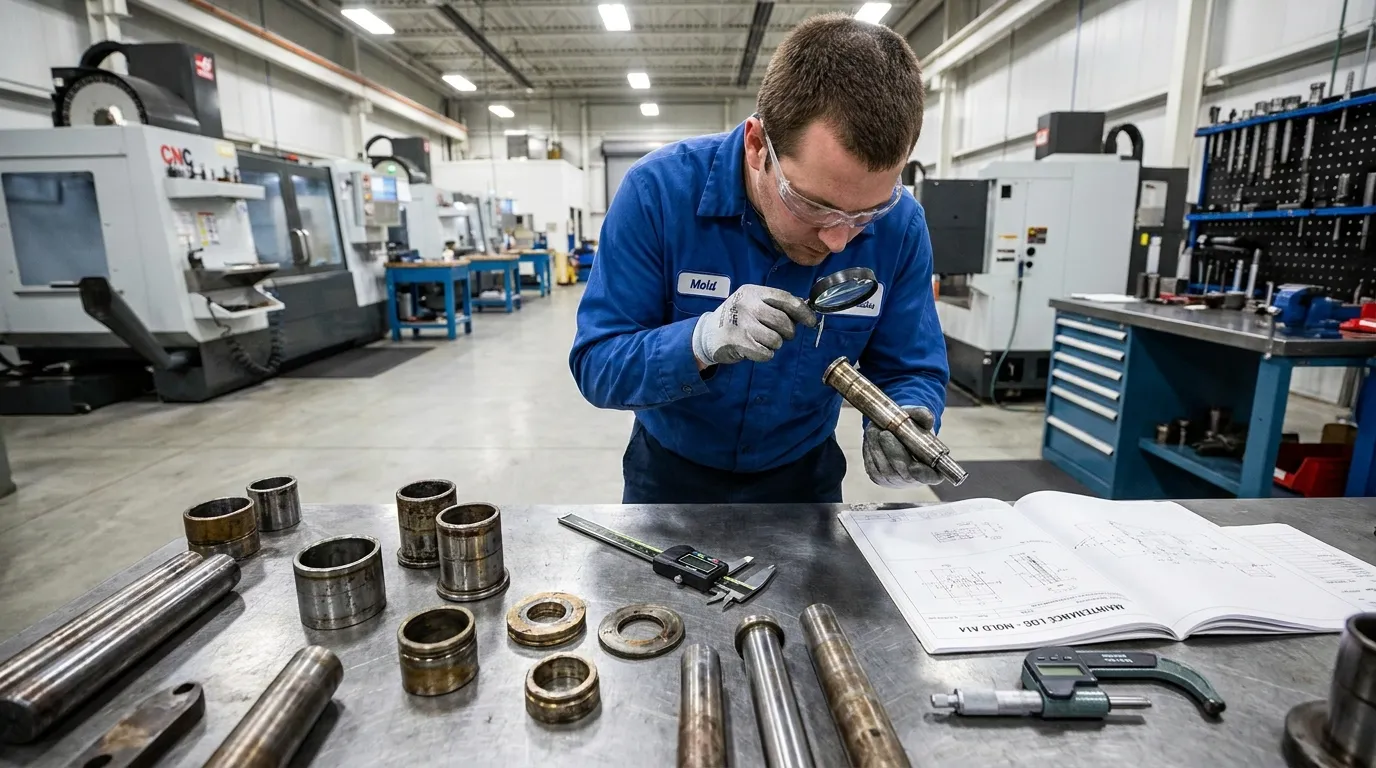
イジェクターピン, 門, スライド, ブッシング, and high-friction inserts usually wear first because they face repeated movement, 圧力, and heat exposure. These components often determine maintenance frequency and unexpected production downtime.
Wear rates depend on resin type, 生産量, and mold design. Abrasive materials such as glass-filled plastics can accelerate wear on ejector systems, 門, and inserts much faster than standard resins.
A high-volume consumer electronics mold using abrasive resin may wear ejector pins within months if low-grade steel was selected. 多くの場合, the issue is not the mold design itself. The problem starts with material hardness and repeated friction during cycling.
エスカテックの射出成形ガイド notes that maintenance planning and component quality heavily influence mold longevity.
金型部品摩耗リスク表
| 構成要素 | 一般的な摩耗原因 | 失敗の症状 | 代替周波数 | Downtime Risk |
|---|---|---|---|---|
| イジェクターピン | Friction and heat | 部品の貼り付け | ハイ | メディア |
| 門 | 高圧流 | フラッシュや不均一なフィル | メディア | メディア |
| ブッシング | 繰り返しのアライメント運動 | ミスアライメント | メディア | ハイ |
| スライドとインサート | 側移動摩擦 | Surface wear | ハイ | ハイ |
| 冷却チャネル | スケールアップ | 不均一な冷却 | 低め | メディア |
Low-cost inserts are not always a bad choice. They can work well for short-run tooling or prototype programs where production cycles remain limited. For long production schedules, hardened components usually provide better long-term value.
一般的なものを比較できます 型損耗部品 when evaluating maintenance planning and spare inventory needs.
Why do cooling and venting systems matter so much?
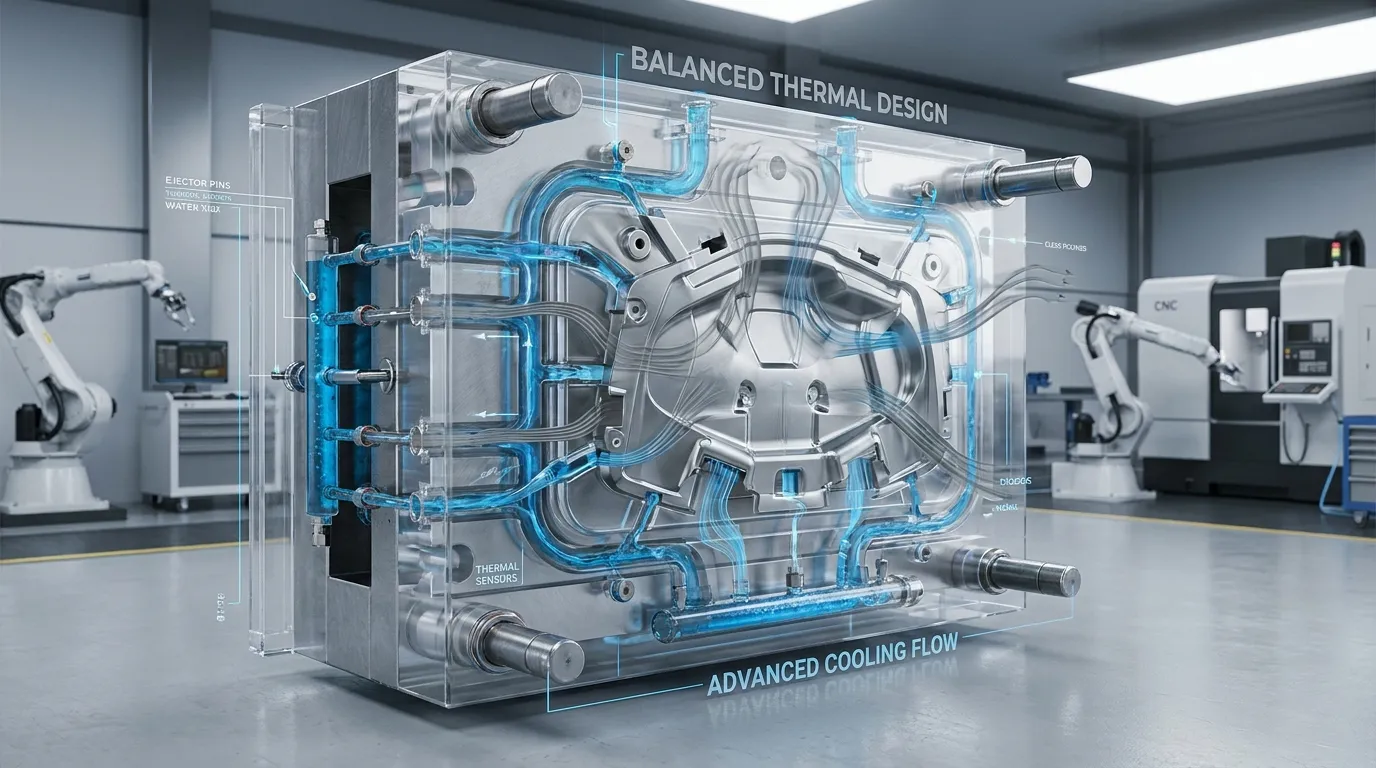
Cooling channels and venting systems directly affect cycle time, 次元安定性, and defect rates. Poor cooling creates warping and uneven shrinkage, while weak venting can trap air and cause burns or incomplete filling.
Cooling systems control how quickly heat leaves the mold after injection. Balanced cooling helps maintain consistent dimensions and stable production cycles. When cooling paths are uneven, one side of the part may shrink faster than the other.
That problem becomes expensive during long production runs. A medical molding supplier reduced cycle variation after redesigning cooling channels for more balanced heat removal. The mold itself did not change significantly, but cooling consistency improved part quality and reduced rejection rates.
Venting systems solve a different problem. Air trapped inside the cavity must escape during filling. 適切な換気がなければ, pressure builds inside the mold and creates burn marks, ショートショット, or trapped gas defects.
エラストロンの射出成形欠陥ガイド explains how poor cooling and venting contribute to common molding defects.
- 埋め戻しの終わり近くの焼け跡
- 不均一な収縮
- 歪んだ部分
- ランダムなショートショット
- 冷却サイクルの延長
- 不整合な寸法
What should buyers inspect before approving mold components?
Buyers should inspect steel grade, 加工精度, 冷却設計, alignment precision, and replaceable wear parts before approving a mold. Early inspection reduces future downtime, defect risk, および修理費用.
Many tooling problems are easier to prevent before production starts. Buyers should review mold drawings, 冷却レイアウト, wear components, and maintenance access before final approval.
Steel hardness matters because it affects wear resistance and long-term dimensional stability. Surface finish quality also affects part appearance and release consistency. Poor machining tolerance can create alignment issues that only appear after thousands of cycles.
A mold producing flash defects is often traced back to worn alignment components rather than machine settings. That’s why guide systems and bushings deserve careful inspection before acceptance.
買い手がサプライヤーに尋ねるべき質問
- What steel grades are used for core and cavity sections?
- Are wear inserts replaceable?
- Which components are standardized?
- How are cooling channels balanced?
- What spare parts are recommended?
- Which components are expected to wear first?
カビ成分検査チェックリスト
| 検査エリア | チェックすべきこと | なぜ重要なのか |
|---|---|---|
| 鋼の硬度 | 材料認証 | 耐摩耗性 |
| 表面仕上げ | 研磨品質 | 見た目の一貫性 |
| 冷却レイアウト | バランスチャネル設計 | 安定したサイクル時間 |
| アライメントシステム | ピンとブッシングの精密さ | フラッシュ防止 |
| 交換可能なインサート | メンテナンスのアクセス | より迅速な修理 |
| 予備部品 | 標準部品の入手可能性 | ダウンタイムの短縮 |
ロドン・グループの調達チェックリスト provides additional supplier evaluation questions for tooling buyers.
さらに例として 標準型金型, buyers can compare commonly used replaceable systems and wear components.
Are premium mold components always worth the cost?
Premium mold components are usually worth the cost for high-volume production, 研磨材料, and tight-tolerance parts. Lower-cost components may work for prototype or low-volume molds with limited production cycles.
Premium components make the biggest difference when molds run continuously or process abrasive materials. 硬化インサート, 精密ガイドシステム, and high-grade cooling hardware usually reduce maintenance frequency in demanding production environments.
That does not mean every project needs top-tier tooling. A low-volume prototype mold with limited production cycles may never recover the added cost of premium wear systems. そういう場合, simpler components often make financial sense.
もし買い手と買い手の比較
| 制作状況 | より良い選択肢 | 理由 |
|---|---|---|
| 大量生産 | プレミアムコンポーネント | より長い耐久性 |
| 研磨樹脂 | 硬化インサート | 摩擦摩耗の減少 |
| 厳密な公差 | 精密アライメントシステム | より良い一貫性 |
| 試作金型 | 標準グレード部品 | 初期費用の低減 |
| 短期間の生産 | 低コストインサート | より速いROIです |
Cheap ejector and guide systems often create repeated downtime during long production runs. The upfront savings may disappear quickly once maintenance interruptions begin affecting output.
Escatecの工具概要 discusses how tooling choices influence maintenance and long-term operating cost.
If you're comparing tooling grades, サンシャイン・プロの 工具構成ガイド can help identify where higher-spec parts matter most.
How can standardized mold components reduce downtime and sourcing delays?
Standardized mold components simplify maintenance, shorten replacement lead times, and reduce sourcing risk. Buyers using standardized systems can replace wear parts faster and minimize production interruptions during supply-chain delays.
When molds rely on custom-only hardware, repairs often take longer and cost more. Standardized guide pins, ブッシング, エジェクターシステム, and inserts are easier to source locally or through multiple suppliers.
That flexibility becomes important during customs delays or international shipping disruptions. A buyer avoided six weeks of downtime because standardized bushings and guide pins were available from a local distributor instead of requiring overseas replacement orders.
Standardization also simplifies spare inventory planning. Maintenance teams can stock fewer unique parts across multiple molds, which lowers inventory complexity and speeds up repairs.
長期生産を計画している買い手は、よく見直すべきです 標準化された金型システム before approving custom tooling configurations.
If you need a broader process-level overview, サンシャイン・プロの plastic injection mold guide explains how tooling systems connect to production planning and mold maintenance.
次のステップを正しく進める
Choosing the right plastic injection mold components is less about buying the most expensive mold and more about matching component quality to production reality. High-volume programs, 研磨樹脂, and tight tolerances usually justify stronger wear systems and precision cooling designs. Prototype tools and short-run molds often need a different balance.
Before approving a mold, focus on cooling layout, wear components, alignment systems, and maintenance accessibility. Those details usually decide whether a mold runs reliably for years or becomes a constant repair problem.
よくある質問
What are the main components of a plastic injection mold?
The main components include the mold base, コアとキャビティ, runner system, 排出システム, 冷却チャネル, vents, and guide components. Each part supports molding accuracy, 冷却効率, part release, or mold alignment.
どの金型部品が最も早く摩耗するか?
イジェクターピン, 門, ブッシング, スライド, and inserts usually wear fastest because they experience repeated movement, 熱, and friction. These components often require the most frequent inspection and replacement.
Why are cooling channels important in injection molds?
Cooling channels control heat removal and cycle consistency during molding. Poor cooling design can increase warping, shrinkage variation, and production delays.
How long does an injection mold last?
Injection mold lifespan depends on steel quality, 樹脂の研磨性, メンテナンスの実践, 生産量. Well-maintained hardened steel molds can last hundreds of thousands or even millions of cycles.
What causes defects in injection molding molds?
Common mold-related defects come from poor venting, cooling imbalance, worn ejector systems, or alignment problems. These issues can create flash, 焼け跡, ショートショット, or dimensional inconsistency.
Are premium mold components necessary for every project?
Premium components are most valuable for high-volume production, 研磨樹脂, and tight-tolerance applications. Lower-cost components may be acceptable for prototypes or short-run tooling.
シェア:



サンシャインより書かれました
サンシャインで, 私たちは精密金型部品の専門製造およびサプライヤーです, プレスおよび射出成形用途向けの幅広い製品を提供しています. 私たちの主な焦点はパンチダイスです, イジェクターピンとスリーブ, ガイドポストとブッシング. 高度なCNC加工技術で, 厳格な品質管理, そして強力な生産能力, 私たちは信頼性を保証しています, 高精度部品, また、迅速かつ効率的なグローバル供給のための在庫の標準部品も併用しています.
ニュース
サービスを受けましょう
あらゆる予算に合った高品質な部品と、親切なスタッフが訓練されていて、訪問を有益で手間なく充実させてくれます.
