



タブレットキャッピングツールソリューション: これだ, ヘッドフラッツ, そして「Dwell」
Tablet capping tooling solutions can help when crown separation is linked to insufficient consolidation time, 空気が閉じ込められている, worn dies, excessive die-wall friction, or ejection stress. They will not correct every capping problem. Poor formulation bonding, inappropriate lubrication, moisture variation, excessive fines, or unsuitable compression settings may produce the same visible defect.
パンチやダイはより広いシステムの一部です。 タブレットプレスの金型タイプ, but this guide focuses only on tooling decisions related to capping. The objective is to prove the likely failure mechanism before changing a die, extending a punch head flat, or adjusting the compression cycle.
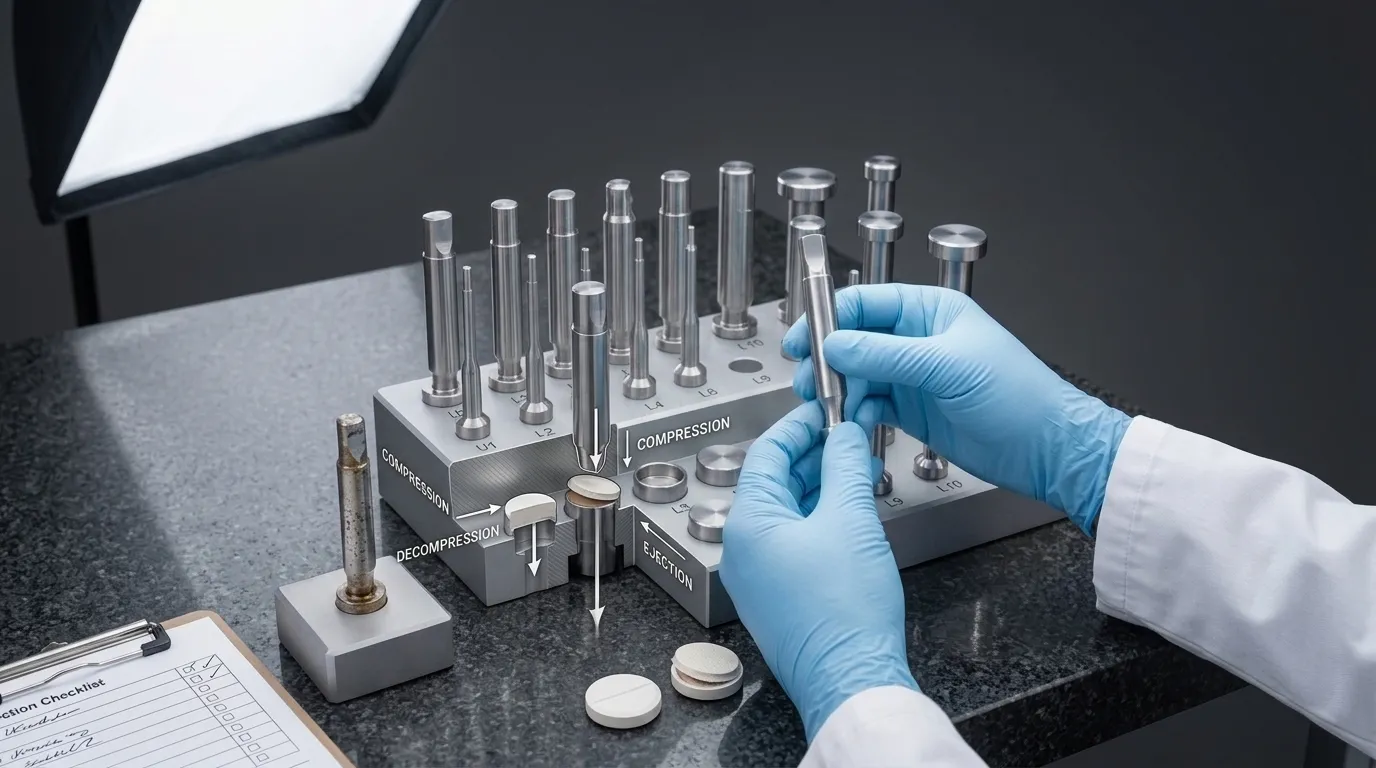
工具交換前に欠陥を確認してください
Capping occurs when the upper or lower crown separates horizontally from the main tablet body. The separation may become visible during decompression, 射出, dedusting, ハンドリング, パッケージング, or mechanical testing.
It must first be distinguished from other defects that need different corrective actions.
| 観察された欠陥 | 典型的な外見 | 初期調査 |
|---|---|---|
| キャップ | 上部または下部の冠は板の胴体から分離しています | Consolidation, 空気が閉じ込められている, decompression, パンチジオメトリ, die condition, および射出 |
| ラミネーション | タブレットは2層以上の水平層に分かれます | Air entrapment, 定式化の性質, compression profile, and elastic recovery |
| チップ | 小さな破片がタブレットの縁から割れています | Cup or land geometry, ハンドリング, tooling damage, granulation, and tablet strength |
| ひび割れ | 完全なクラウン分離がない場合、目に見える亀裂が形成されます | Stress distribution, deep cups, formulation elasticity, および圧縮条件 |
| ピッキング | 素材はパンチ面にくっつき、タブレット表面から剥がれます | パンチフェイス条件, formulation adhesion, 水分, エンボス加工, 潤滑 |
Document exactly when and where the defect occurs. Record whether it affects:
- the upper crown, lower crown, あるいはその両方;
- every tooling station or only selected stations;
- low-speed and high-speed production equally;
- tablets immediately after compression or only after handling;
- a complete batch or intermittent production periods.
A defect concentrated at one or two tooling stations is more likely to involve local punch or die condition than a defect occurring uniformly across the turret. Uniform capping across all stations may still involve tooling design, but formulation and process variables require equal attention.
Decide Whether the Root Cause Is Formulation, プロセス, Press, or Tooling
“Improper tooling” is not a complete diagnosis. Before ordering modified punches or dies, separate four possible source groups.
定式化に関連する証拠 may include poor tabletability, weak binder performance, excessive elastic recovery, inconsistent moisture, unsuitable particle-size distribution, high fines content, or excessive lubrication. A formulation that cannot develop adequate interparticle bonds may continue to cap even when dwell is increased.
プロセス関連の証拠 may include ineffective precompression, a rapid loading profile, unsuitable main-compression conditions, inconsistent die fill, or changing feed behaviour. Simply increasing compression force may make capping worse if the formulation experiences excessive elastic recovery after unloading.
報道関連の証拠 may appear during scale-up. A formulation may run successfully on a development press but fail on a production rotary press because punch velocity, turret geometry, compression-roller geometry, and available dwell differ.
工具関連の証拠 includes die-bore wear, 得点, abnormal clearance, damaged punch features, local contamination, unusually high ejection resistance, or a defect limited to specific stations.
The investigation should ask a simple question: What changed when the capping changed? If the defect follows a formulation batch, it may not be a tooling problem. If it follows an individual die around the turret, tooling becomes a stronger suspect.
問題が工具に関連している可能性を示す証拠
A tooling investigation is justified when one or more of these conditions are present:
- Capping repeatedly occurs at the same station.
- Affected dies show scoring, 粗さ, deposits, 腐食, or a visible wear ring.
- Punch-tip or die-bore measurements differ between good and defective stations.
- The tablet shows heavy belly-band marks or damage during ejection.
- Ejection resistance rises as the run continues.
- Controlled reduction in turret speed improves the defect without other changes.
- Increasing available dwell improves tablet strength or reduces crown separation.
- Replacement with an inspected punch or die removes the station-specific defect.
These observations do not prove the final solution, but they narrow the investigation enough to justify dimensional inspection or a controlled tooling trial.
パンチヘッドフラットが滞留時間を変える方法
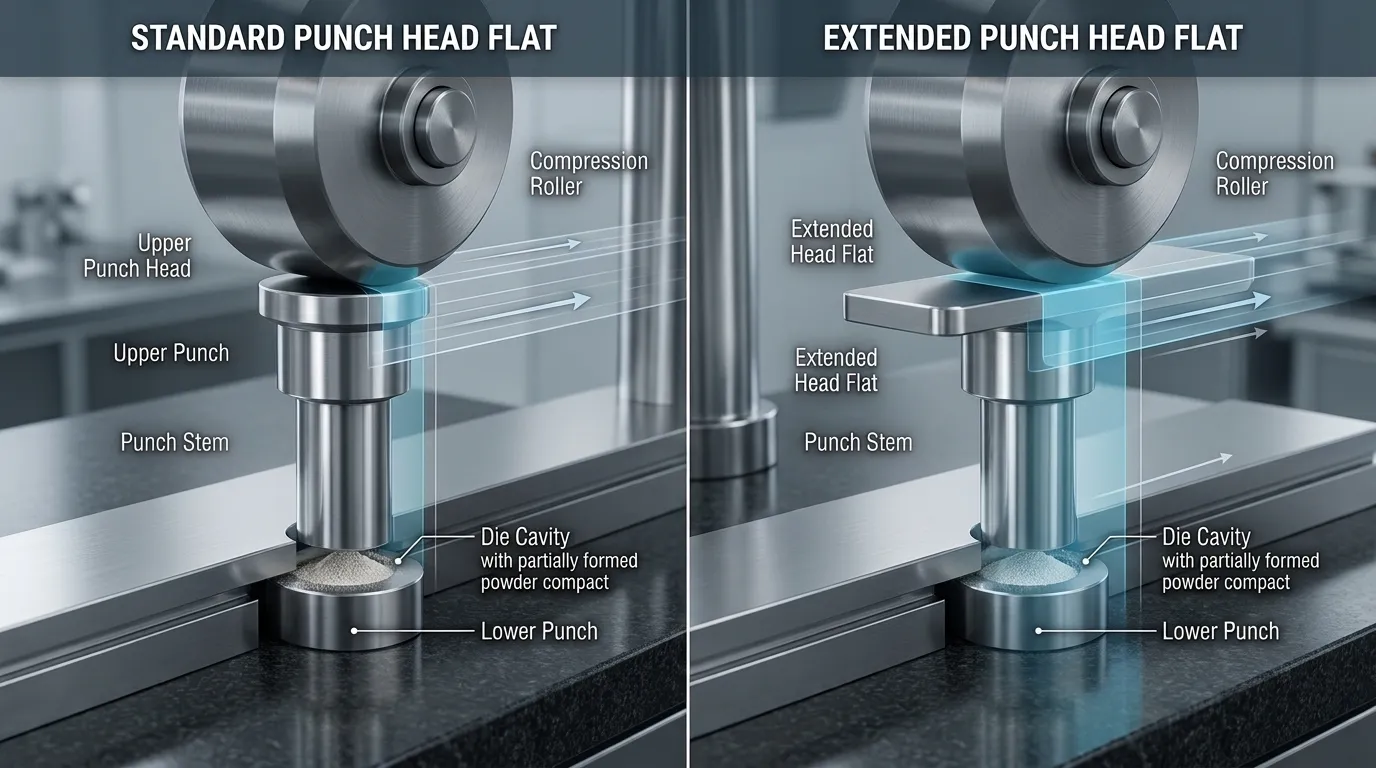
The punch head contacts the compression roller as the tooling moves through the compression zone. The flat region of the head affects the period during which the punch remains at or near its maximum penetration.
That period is commonly described as dwell time. It gives the powder bed additional time for particle rearrangement, 変形, fragmentation, and bond formation under compression.
Dwell is not determined by turret revolutions per minute alone. It is influenced by:
- punch-head profile;
- head-flat dimensions;
- 砲塔速度;
- pitch-circle diameter;
- compression-roller geometry;
- punch velocity through the compression zone.
Two presses running at the same turret speed may therefore expose the formulation to different loading rates and dwell conditions.
A formulation with strong strain-rate sensitivity may form acceptable tablets when compressed slowly but lose tensile strength as punch velocity increases. その場合, a longer head flat may extend the high-compression portion of the cycle and provide more consolidation time.
査読付き研究 パンチヘッド設計とメトホルミン錠剤の品質 found that changing the head design affected dwell and the resulting physical properties of the tablets under the studied conditions. The result supports the mechanism, but it does not establish one ideal head-flat size for every formulation or press.
ヘッドフラットを伸ばすと助けになるかもしれません
An extended head flat deserves evaluation when:
- capping appears or becomes worse as turret speed increases;
- the formulation performs better at slower compression rates;
- tablet strength declines when moving from a development press to a faster rotary press;
- a controlled lower-speed trial improves the defect;
- die inspection does not reveal a more direct mechanical cause;
- the formulation has demonstrated strain-rate sensitivity.
The modified head must still be compatible with the press, ローラー, 砲塔, ガイド, and tooling standard. Increasing the flat is not simply a matter of adding more material. The profile must pass through the complete machine cycle without interference or excessive mechanical loading.
Production consequences must also be considered. Reducing turret speed may prove that additional dwell helps, but it may not be an acceptable permanent solution because output falls. A compatible extended-head-flat design may preserve more output, but only after the mechanism and machine limitations are confirmed.
長時間の滞留がキャップ問題を解決しにくい場合
Longer dwell is a weak solution when:
- the formulation has poor inherent bonding;
- binder, 水分, granulation, or lubricant conditions are outside the suitable range;
- the defect does not change during controlled speed trials;
- dies have severe wear or scoring;
- tablets are damaged mainly during ejection;
- excessive elastic recovery remains after dwell changes;
- increasing consolidation time improves hardness but creates friability, dissolution, or other quality problems.
There is no universal ideal dwell time. The relevant measure is whether a controlled dwell change produces a repeatable improvement while other variables remain stable.
Inspect the Dies, クリアランス, and Bore Condition
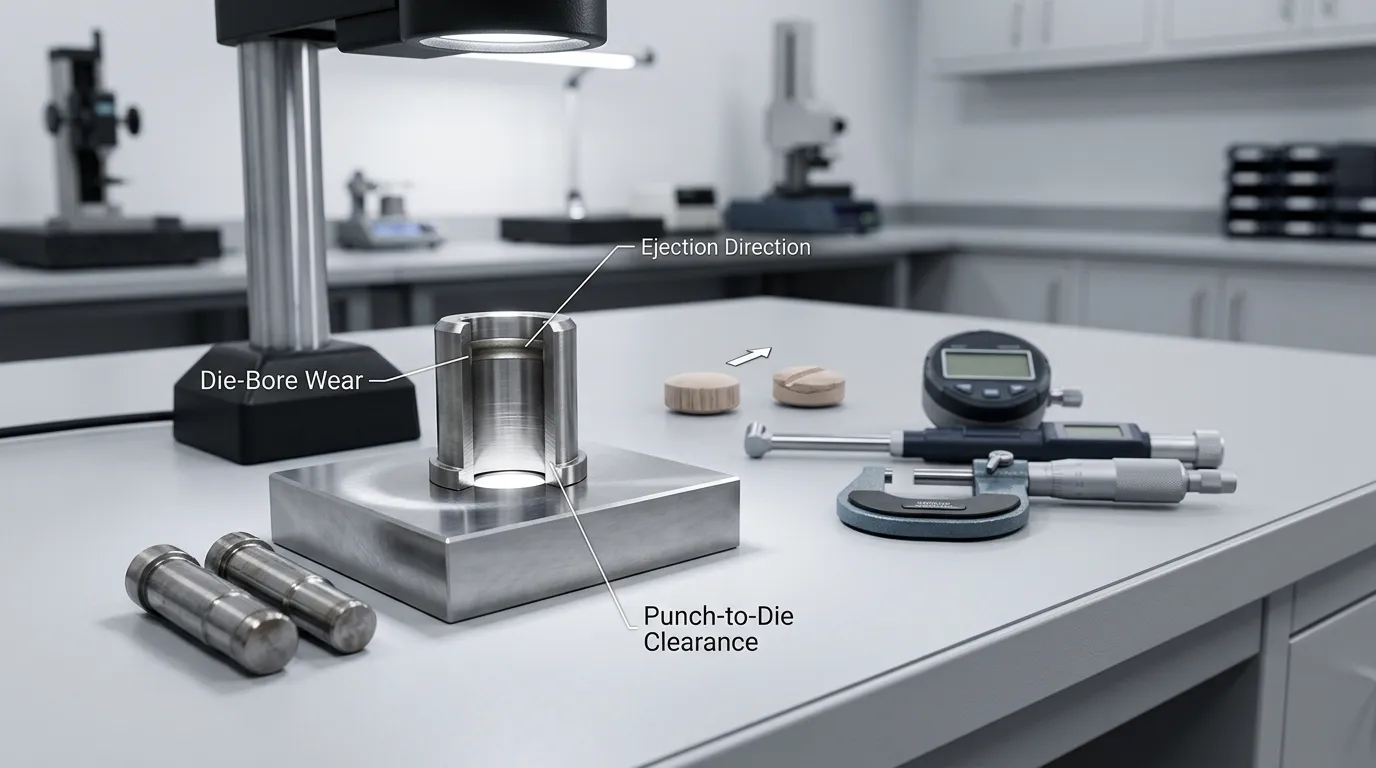
The die controls the powder bed during filling, 圧縮, decompression, および射出. Its bore condition can influence friction, residual stress, tablet movement, および表面損傷.
Clean the die before inspection. Deposits can hide wear or create a false impression of bore damage. Then examine and measure the following:
- Bore surface: 得点を狙いましょう, 粗さ, 腐食, 接着材料, and polishing differences.
- Wear-ring area: Check for localized enlargement where maximum compression repeatedly occurs.
- Bore profile: Compare measurements at several heights rather than relying on one diameter reading.
- Punch-tip-to-die clearance: Compare good and problematic stations against the approved tooling drawing.
- Punch-tip condition: Inspect edges, カップ, 土地, and relief areas for wear or damage.
- Station pattern: Determine whether defects follow a specific die, punch, or turret position.
- Ejection marks: Inspect the tablet belly band for scratches, ドラッグマーク, or localized damage.
A wear ring may increase resistance as the tablet moves from an enlarged compression zone into a narrower part of the bore. Roughness and scoring can also raise die-wall friction. Both conditions can increase ejection stress and expose a tablet that already has weak internal bonding.
There is no universal wear or clearance limit that applies to every tablet size, 工具規格, 定式化, そして報道. Acceptance should be based on approved drawings, 検査方法, historical performance, and application-specific engineering review.
サンシャインプロズ タブレットプレスの工具ページ states that tablet punches and dies can be processed from drawings or samples. Its stated tolerance accuracy should be treated as a general product-page claim, not as an automatic guarantee for every feature of every tooling order.
ストレートダイとテーパーダイの比較
A straight die maintains its specified bore profile through the working section. A tapered die includes a deliberately changing diameter in a defined area.
| オプション | 評価の理由として考えられます | 証拠が必要です | 主な制限 |
| ストレートダイス | 標準的な圧縮および射出条件 | Stable compression, acceptable friction, and no air-release problem linked to geometry | すべての空気の閉じ込めや排出機構に対応しているわけではありません |
| テーパードダイ | Application-specific support for air release, decompression, or ejection | キャッピングがこれらのメカニズムのいずれかに結びついている再現可能な証拠 | Taper direction, 金額, 長さ, and location are not universal |
| 補正ボア付きの交換ダイ | Existing die is worn, 得点, or dimensionally unsuitable | Bore measurements, station pattern, and ejection evidence | 交換しても製剤の故障は修正されません |
A tapered die should not be selected merely because capping exists. The intended mechanism must be identified first. Taper designed to influence air release is a different engineering decision from taper intended to change tablet release or ejection behaviour.
SunshinePro’s website does not specifically confirm tapered tablet-die capability. Any such requirement would need written feasibility confirmation based on the exact drawing and application.
Account for Trapped Air, プレコンプレッション, and Decompression
Powder contains air within the spaces between particles. As the punches enter the die and reduce the powder-bed volume, that air must escape or be redistributed.
If compression occurs too rapidly, internal air pressure can rise before sufficient venting and consolidation take place. 研究 圧縮粉末床内の気圧発生 connects this internal pressure with defects including cracking, bubbling, and capping.
Precompression can help by applying an earlier, lower compression event before main compression. Its purpose may include:
- removing part of the entrapped air;
- beginning particle rearrangement;
- forming a weak initial compact;
- reducing the abruptness of the main-compression event.
More precompression is not automatically better. Its effectiveness depends on penetration, loading rate, 定式化の挙動, and the relationship between the precompression and main-compression stages. A study of イブプロフェン錠剤における前圧迫および主圧迫 showed that these settings can materially affect resulting tablet properties under the tested conditions.
During decompression, the applied load is removed and the compact recovers elastically. If interparticle bonds are too weak, or internal air and residual stresses are too high, the crown may begin separating at this stage.
Tooling geometry, press settings, and formulation behaviour must therefore be evaluated together. A modified die cannot compensate for every air-management problem, and additional dwell cannot always overcome poor bonding.
ダイウォール摩擦と排莢応力の確認
After compression, the lower punch pushes the tablet upward through the die. The tablet remains in contact with the bore, and its resistance to movement depends on surface condition, 潤滑, radial pressure, material properties, および工具寸法.
High die-wall friction may be associated with:
- rough or scored die surfaces;
- a wear ring;
- adhered product;
- 潤滑不足;
- inconsistent lubricant distribution;
- unsuitable punch-tip-to-die clearance;
- high residual radial pressure;
- an abrasive formulation.
Warning signs include heavy belly-band marks, delayed crown separation, rising ejection resistance, station-specific defects, or tablets breaking as they leave the die.
Ejection-force trends are generally more informative than one isolated reading. A gradual rise during production may indicate increasing deposits, temperature-related changes, or lubrication problems. A sharp difference at one station may point toward local die or punch condition.
No universal ejection-force threshold can be applied to every product. The measurement must be interpreted against tablet size, 定式化, プレスセットアップ, tooling dimensions, historical performance, and the validated process.
制御されたトラブルシューティングシーケンスを使いましょう
Changing speed, 力, プレコンプレッション, 潤滑, and tooling at the same time may reduce the defect, but it will not reveal which change worked. Use a controlled sequence instead.
- Confirm the defect. Record whether the failure is capping, ラミネート加工, 欠け声, or another defect.
- Record when it appears. Note compression, decompression, 射出, dedusting, ハンドリング, or delayed testing.
- Map affected stations. Determine whether capping follows individual punches, これだ, or turret positions.
- Hold the formulation stable. Avoid comparing unrelated batches when testing tooling hypotheses.
- Inspect punches and dies. Clean, measure, and compare good and defective stations.
- Run a controlled speed trial. Change turret speed while holding other practical variables constant.
- Evaluate precompression separately. Adjust one relevant condition at a time and document the response.
- Review ejection behaviour. Check tablet surfaces, die condition, and available force trends.
- Trial one tooling change. Do not test a new die, extended flat, different cup, and new material simultaneously.
- Define success before the trial. Specify acceptable visual defects, tensile strength or breaking force, 厚さ, friability, output, and relevant process limits.
その FDAの剤形検査ガイド discusses the need to maintain tablet punches and dies and to use appropriate in-process controls. A troubleshooting trial should therefore consider more than the visual disappearance of capping. The resulting tablet must still meet its broader quality requirements.
エビデンスとツールの応答を一致させる
| 観察 | 調査の考えられるメカニズム | 確認試験 | 可能な対応 | 制限 |
| キャップは速度が進むにつれて増加し、速度が下がると改善されます | 滞留感度やひずみ率感度の不足 | 制御速度比較 | 互換性のあるエクステンデッドヘッドフラット金型の評価 | 本来の結合不良を直すことはできません |
| 欠陥は1つのダイ位置に沿っています | Local wear, 粗さ, 汚染, or dimensional change | Clean, 検査, measure, and swap positions where permitted | エンジニアリング評価後の修理または交換 | 交換してもバッチ全体の製剤失敗は修正されません |
| プレコンプレッションによるキャップの変更 | 空気放出または早期固結の問題 | 制御された前圧迫試験 | Optimize process; evaluate tooling geometry only if evidence supports it | 過度な前圧縮は他の問題を引き起こす可能性があります |
| 高い射出抵抗と腹部バンド損傷 | ダイウォール摩擦またはボア状態 | 力の傾向を確認し、ダイ表面を点検してください | Correct lubrication, 表面, クリアランス, または損傷した金型 | 普遍的な力の制限は適用されません |
| 速度や工具ステーションでキャップが持続します | 製剤またはより広範なプロセス制限 | 圧縮と定式化のレビュー | 製剤やプロセス開発への回帰 | 新しい金型は機構を修正せずにコストを増やす可能性があります |
| クラウン幾何学は非常に応力が強いように見える | カップや土地のデザインが影響することがあります | 承認された設計と機械的結果を比較する | パンチフェイス幾何学の復習 | 別の設計評価に属します |
カップの深さをデフォルトの解決策にしないように考慮しましょう
Cup depth and punch-face edge geometry affect tablet shape, volume, crown thickness, and stress distribution. Deep cups or unsuitable edge geometry may create mechanical conditions that contribute to cracking or cap separation in some products.
Changing the cup can also alter tablet appearance, weight-volume relationships, edge strength, packaging behaviour, and compression response. It should not be treated as a simple secondary adjustment after dwell or die changes fail.
詳細な選考は以下のガイドに掲載されています。 タブレットパンチカップの深さ設計. For a capping investigation, cup depth should remain one possible contributing factor rather than the default explanation.
工具サプライヤーが必要とするデータを準備する
A supplier cannot responsibly evaluate “anti-capping tooling” from the defect name alone. Prepare a technical data package that includes:
- tablet press manufacturer and model;
- tooling standard and approved drawings;
- turret speed and number of stations;
- available press geometry or dwell information;
- current punch-head profile and dimensions;
- upper- and lower-punch drawings;
- die-bore dimensions and inspection results;
- tablet diameter, 形状, 重量, 厚さ, cup depth, and land;
- formulation and granulation route;
- evidence of speed sensitivity;
- precompression and main-compression conditions;
- defect photographs;
- affected station numbers;
- ボア, punch-tip, and clearance measurements;
- ejection observations or force trends;
- results from controlled trials;
- required material and inspection documentation;
- measurable trial-acceptance criteria.
This information lets the supplier evaluate compatibility and determine whether a replacement die, modified head profile, or another intervention is technically reasonable.
It also prevents an expensive mistake: ordering a complete tooling set before proving that the current tooling caused the defect.
SunshineProが提供できるものとできないもの
SunshinePro’s published tablet-tooling information supports a limited set of company-specific statements.
| ウェブサイトで確認済み | 直接の確認が必要です |
| タブレットプレスはパンチとダイニングをします | 伸び頭平らなタブレットパンチ |
| 製品にプレミアム高速鋼が掲載されています | キャップ用に設計されたテーパー型タブレットダイ |
| 図面やサンプルからのカスタム処理 | 滞留時間計算または圧縮サイクルモデリング |
| 標準サイズおよび非標準サイズのカスタマイズ | 圧縮シミュレーションまたはひずみ率試験 |
| 一般的なパンチングヘッドのカスタマイズ | 名前付きTSMまたはEUツール標準互換性 |
| 材料選択のアドバイス | 射出力試験 |
| 材料検査報告書は利用可能と記載されています | 上限の確実な廃止または削減 |
| Product-page tolerance claim of ±0.002 mm | その許容範囲をすべての特徴と順序に適用すること |
The appropriate commercial step is therefore a technical feasibility review, not an assumption that every capping-related modification is already available.
Submit approved drawings, samples where appropriate, inspection data, press details, and trial results through the タブレットプレス工具製品ページ or the company’s enquiry channel.
証拠に基づいて次の行動を選ぶ
Use the dominant evidence to decide where the investigation should go next:
- Formulation evidence dominates: return the problem to formulation or process development.
- Speed-sensitive capping improves with controlled dwell changes: evaluate press-compatible head-flat options.
- Air-management evidence dominates: optimize the compression sequence before redesigning the die.
- Die wear or scoring is confirmed: assess repair or replacement against approved dimensions.
- Ejection stress dominates: investigate bore condition, 潤滑, クリアランス, and lower-punch behaviour.
- Cup geometry remains a credible factor: conduct a separate punch-face design review.
- Evidence remains mixed: continue controlled testing rather than ordering a full tooling set.
When the results point to a tooling-related mechanism, send the press information, ドローイング, defect records, inspection findings, and trial data through SunshinePro’s お問い合わせページ. The objective should be an application-specific feasibility review of the punches or dies—not a generic request for a guaranteed capping cure.



サンシャインより書かれました
サンシャインで, 私たちは精密金型部品の専門製造およびサプライヤーです, プレスおよび射出成形用途向けの幅広い製品を提供しています. 私たちの主な焦点はパンチダイスです, イジェクターピンとスリーブ, ガイドポストとブッシング. 高度なCNC加工技術で, 厳格な品質管理, そして強力な生産能力, 私たちは信頼性を保証しています, 高精度部品, また、迅速かつ効率的なグローバル供給のための在庫の標準部品も併用しています.
ニュース
サービスを受けましょう
あらゆる予算に合った高品質な部品と、親切なスタッフが訓練されていて、訪問を有益で手間なく充実させてくれます.
