



タブレット型材の摩耗による鋼材選択, Corrosion, および負荷
Tablet tooling steel selection should start with the application, not a familiar grade name. The right material depends on three main pressures: abrasive wear from the formulation, corrosion from product or cleaning exposure, and mechanical load from compression, 影響, 曲げる, and tablet ejection.
Material selection also comes after the tooling format and press compatibility have been established. For that broader context, review the available タブレットプレスの金型タイプ. This guide focuses only on choosing the steel or material family for the punches and dies.
No single steel is best in every condition. A wear-resistant grade may chip in a high-impact application, while a tough grade may wear too quickly against an abrasive formulation. The goal is to identify the dominant risk, account for secondary risks, and specify the material condition clearly enough for a supplier to evaluate it.
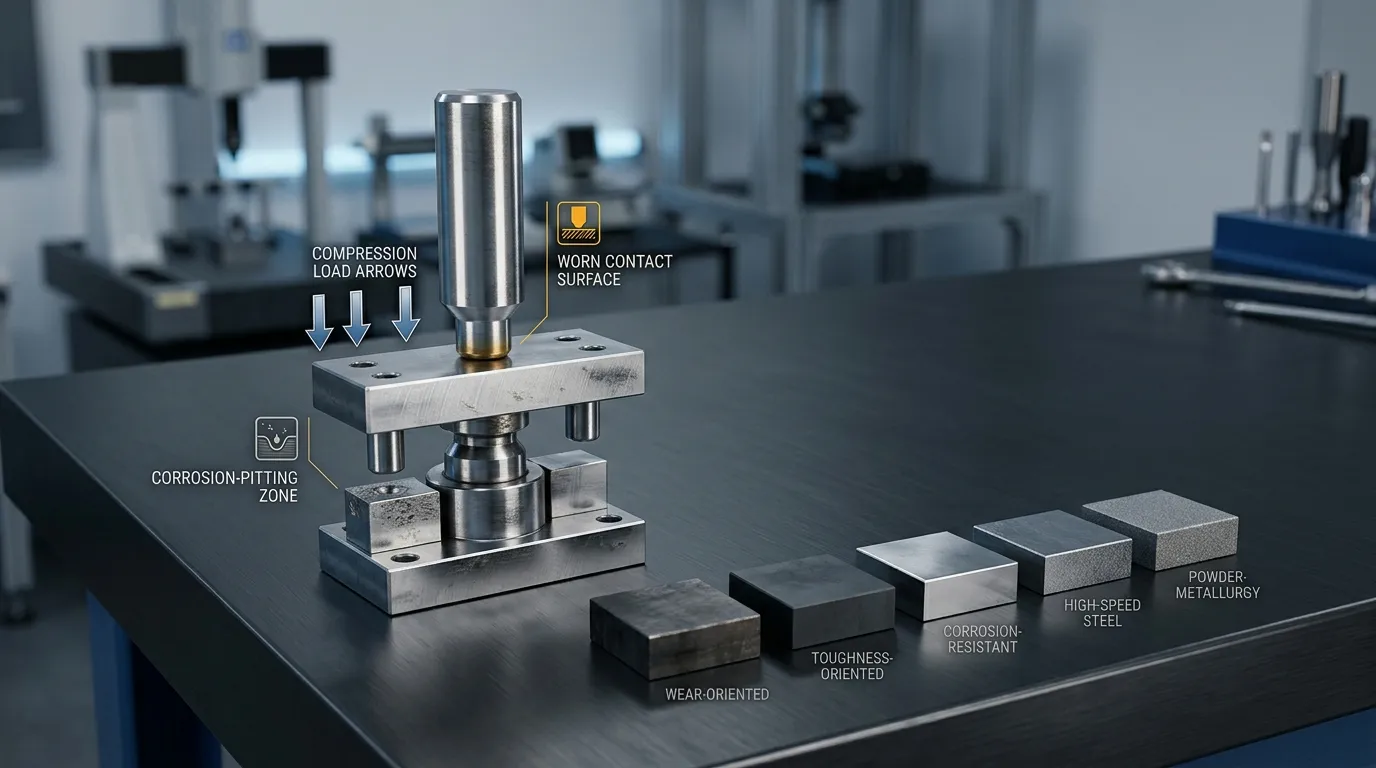
Start With the Application, スチールグレードではありません
A material name alone does not describe the conditions the tooling must survive. Before comparing D2, S7, 440C, 高速鋼, or powder-metallurgy grades, collect the application data that controls the decision.
Review the following factors:
- Formulation characteristics: Identify hard minerals, crystalline ingredients, salts, acids, chlorides, 水分, and other substances that may cause wear or corrosion.
- タブレットの形状: Record the cup depth, punch-tip diameter, エンボス加工, スコアライン, narrow features, and sharp transitions that may concentrate stress.
- Compression conditions: Document the operating load, 速度, pre-compression arrangement, and any history of overloaded or damaged tooling.
- Ejection behavior: High ejection resistance can increase stress on the lower punch and friction against the die bore.
- Cleaning exposure: Include cleaning chemicals, water quality, contact time, 乾燥方法, and storage conditions.
- Current failure symptoms: Note where wear, ピットティング, 欠け声, ひび割れ, 変形, or dimensional change appears.
- Production demand: Consider run length, changeover frequency, inspection intervals, and the cost of unplanned tooling replacement.
These inputs are more useful than simply telling a supplier that the tablets are pharmaceutical, ニュートラシューティカル, or chemical products. Two formulations in the same category can create very different tooling conditions.
Identify the Dominant Failure Risk
The first step is deciding which failure mechanism deserves the highest priority.
| 観察状態 | Likely risk | Material property to prioritize | Other factors to check |
|---|---|---|---|
| Gradual loss of punch-face detail or die-bore size | 研磨摩耗 | Wear resistance and retained hardness | Particle hardness, 表面仕上げ, 生産量 |
| スメアリング, 腹立たしい, or metal transfer | 接着性摩耗 | Surface compatibility and finish | 潤滑, アライメント, コーティング, 接触圧力 |
| Staining, rough spots, or localized pits | Corrosion | Corrosion and pitting resistance | Formulation chemistry, cleaning agent, 乾燥 |
| Repeated tip chipping or cracking | Fracture | Toughness and stress resistance | カップ戦の深さ, エンボス加工, アライメント, 熱処理 |
| Permanent deformation | Excessive load | Compressive strength and final hardness | プレス設定, 工具寸法, overload history |
| Uneven wear around the tool | Misalignment or uneven loading | Not necessarily a steel problem | Press condition, ガイド, セットアップ, 工具形状 |
使用歴, 腐食, and fracture can produce similar early symptoms. A rough punch face, 例えば, may result from corrosion, abrasive attack, poor polishing, coating damage, or adhesive transfer. Changing steel before confirming the failure mechanism may replace one problem with another.
Assess Combined Conditions
Many applications do not fit into one category.
An abrasive and corrosive formulation needs more than maximum hardness. A highly wear-resistant grade may still suffer surface attack, while a corrosion-resistant steel may lose dimensions too quickly under severe abrasion.
A high-load and abrasive application creates a different balance. Wear resistance matters, but the punch must also tolerate impact, 曲げる, and local stress around deep cups, narrow tips, スコアライン, or detailed embossing.
Use three questions to frame the shortlist:
- Which condition is most likely to stop production first?
- Which secondary condition could eliminate an otherwise suitable grade?
- Can the risk be controlled through component-specific materials, 熱処理, 表面仕上げ, またはコーティング?
Where all three risks are high, published grade descriptions may not be enough. A supplier review, sample tooling, and controlled production trial may be more reliable than a universal recommendation.
Balance Wear Resistance, 靭性, 耐食性, and Strength
Tool steel properties interact. Improving one property does not guarantee better overall performance.
耐摩耗性 helps the punch face and die bore retain dimensions against hard particles and repeated contact. It is especially important when the formulation contains abrasive minerals or crystalline ingredients.
靭性 describes the steel’s ability to tolerate impact, 曲げる, and stress without chipping or cracking. It becomes more important around thin punch tips, 深いカップ, sharp engraving, and other stress-concentrating features.
圧縮強度 helps the tooling resist permanent deformation under compaction pressure. This is different from toughness: a material can resist deformation yet remain vulnerable to brittle fracture.
耐腐食性 matters when the tooling contacts moisture, acids, salts, chlorides, reactive ingredients, or aggressive cleaning chemicals. The actual exposure conditions matter more than a broad label such as “stainless.”
Dimensional stability affects whether the tooling retains critical geometry after heat treatment and during repeated use. It also influences the consistency of tablet dimensions and tooling interchangeability.
Polishability and surface retention affect friction, product release, 掃除, embossing definition, and the tendency for material to adhere to the working surface.
Why Harder Is Not Automatically Better
Hardness is easy to compare, which is why buyers sometimes use it as the primary specification. That can be misleading.
Higher hardness may improve resistance to abrasive wear, but it does not automatically improve toughness, corrosion behavior, 次元安定性, or resistance to impact. A very hard punch can still fail early if its geometry creates a sharp stress concentration or the press applies an uneven bending load.
The final decision should consider four items together:
- Exact steel grade
- 熱処理条件
- 最終硬度
- Actual component geometry and duty
A hardness number without the grade, 熱処理記録, and application context is an incomplete specification.
Compare Steel Families by Their Best-Fit Conditions
Common tablet-tooling materials are better understood as conditional options rather than a ranked list.
| 物質的家族 | 典型的な選択強度 | Main limitation to review | Possible application signal | What the buyer should verify |
| D2-type cold-work steel | Strong abrasive-wear resistance | Lower tolerance for cracking than toughness-oriented grades | Wear-dominant application with controlled impact | 正確なグレード, 熱処理, 硬度, 幾何学 |
| S7-type shock-resisting steel | High toughness and impact resistance | May not provide the highest wear resistance | チップ, ショック, 曲げる, or fracture is the main risk | Final condition, wear demand, 表面処理 |
| 440C stainless steel | Corrosion resistance with high attainable hardness | Not corrosion-proof; wear and toughness still require review | Product or cleaning exposure creates significant corrosion risk | Exposure chemistry, 硬度, passivation or finish |
| 高速鋼 | Useful hardness, 耐摩耗性, and strength depending on grade | “HSS” covers many compositions and conditions | Supplier offers a defined HSS grade suited to the application | Exact designation, 化学, 熱処理, reports |
| 粉末冶金工具鋼 | Potentially strong balance of wear, タフネス, 強度, そして安定性 | Cost and properties vary significantly by grade | Combined conditions exceed conventional-grade capability | Exact PM grade, published data, trial evidence |
| Carbide or carbide-lined die | Very high wear and compressive resistance | Brittleness and application compatibility | Severe die-bore wear is the dominant problem | Insert design, 衝撃リスク, formulation compatibility |
Official technical documentation for a D2-equivalent grade such as Uddeholm Sverker 21 describes a profile centered on abrasive-wear resistance, with cracking resistance remaining an important limitation. An S7-based grade such as Uddeholm Compax Supreme places more emphasis on toughness and heavy-duty impact conditions.
That distinction is useful, but it should not become a universal D2-versus-S7 verdict. A more focused comparison belongs in D2 vs S7 steel for tablet punches.
For corrosion-oriented applications, BÖHLER N695 そして Carpenter 440C provide useful reference information for 440C-type martensitic stainless steel. The material can achieve high hardness while offering stainless characteristics, but its suitability still depends on the specific chemical exposure and final condition.
Powder-metallurgy steel is also not one uniform category. A specific grade such as Uddeholm Vanadis 4 Extra is designed around a particular balance of ductility, 耐摩耗性, 圧縮強度, および次元安定性. Those attributes cannot be assumed for every steel produced through a PM process.
Treat Generic Labels as Incomplete Specifications
Terms such as “HSS,” “stainless steel,” and “PM steel” identify broad families, not complete tooling specifications.
仕入先に確認してもらいましょう:
- Exact grade or recognized equivalent
- Whether the material applies to the punch, その, 挿入, or complete tooling set
- Heat or lot traceability
- 熱処理条件
- 最終硬度
- 表面仕上げ
- Coating or other surface treatment
- Dimensional inspection requirements
サンシャインプロズ タブレットプレスの金型 page lists Premium High-Speed Steel, CNC加工, 熱処理, 図面やサンプルからのカスタム処理. The page does not identify the exact HSS grade, so that detail should be confirmed for the specific application rather than assumed.
Select Punch and Die Materials by Component Duty
Punches and dies operate as a set, but they do not experience identical conditions.
| Component area | Main duty | Typical material concern |
| Upper punch tip | Compresses and forms the upper tablet face | Face wear, 欠け声, embossing damage, local stress |
| Lower punch tip | Supports compression and ejects the tablet | 使用歴, ejection load, 摩擦, エッジダメージ |
| Punch neck and barrel | Transfers load and maintains alignment | Bending, 疲労, 寸法精度 |
| Punch head | Contacts press cams and rollers | 影響, 接触摩耗, head-profile accuracy |
| ボア | Contains powder and guides compression and ejection | 研磨摩耗, 径状圧力, 腐食, dimensional enlargement |
A punch with a deep concave cup or narrow tip may require greater fracture resistance than a broad, shallow punch used under similar compression conditions. Detailed embossing and break lines can also create local stress concentrations.
The die bore has a different priority. It experiences repeated contact with powder and the tablet edge, radial pressure during compression, and friction during ejection. Gradual die-bore wear may change tablet diameter and ejection behavior even when the punches remain usable.
For severe applications, the most suitable solution may involve different material priorities for punches and dies rather than one grade for the entire set.
Check Heat Treatment, 表面仕上げ, コーティング, and Press Condition
A correct nominal grade can still perform poorly when its final condition or operating environment is unsuitable.
熱処理 develops the steel’s working hardness, タフネス, 次元安定性, and residual-stress condition. Two tools made from nominally the same grade may behave differently if their heat treatment differs.
Grinding and polishing influence friction, 接着, 掃除, and local stress. グラインドダメージ, sharp transitions, or an unstable polished finish can shorten service life.
Surface coatings may reduce friction, adhesive pickup, 使用期間, or corrosion under appropriate conditions. They remain part of a material system, not a replacement for the base steel. A coating cannot correct inadequate substrate toughness, poor heat treatment, 不適切な幾何学, or press misalignment.
Press condition can overload an otherwise appropriate tool. 査読付きレビュー An Update on Advancements in Tablet Tooling Technology discusses the interaction among tooling design, スチール, コーティング, 使用期間, 腐食, そしてずれ. That interaction is why material changes should follow a root-cause review rather than replace one.
Do Not Blame the Steel Before Checking Alignment and Geometry
Repeated breakage in the same location may indicate an alignment, セットアップ, or geometry problem.
確認:
- Uneven wear around the punch or die
- Contact marks on one side of the tooling
- Repeated failure at a narrow tip or sharp transition
- Excessively deep cups
- Fine embossing or break lines that create local stress
- Damaged guides or inconsistent press setup
A tougher steel may tolerate more abuse, but it cannot correct misalignment. Similarly, a harder steel may slow surface wear while making a stressed punch feature more vulnerable to chipping.
Use a Wear–Corrosion–Load Matrix to Build the Shortlist
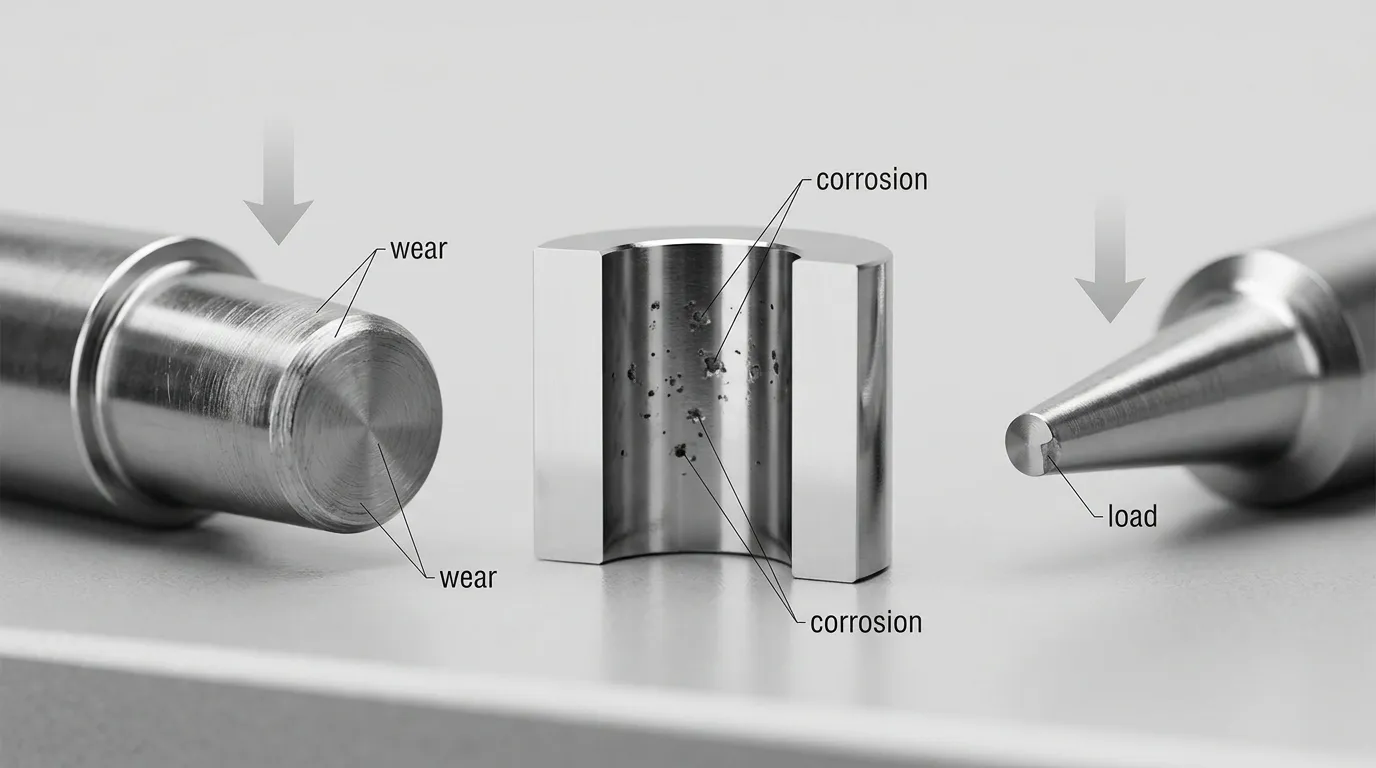
The following matrix is a practical starting point. It does not replace an application-specific material review.
| Wear risk | 腐食リスク | Load risk | Initial selection direction |
| ハイ | 低め | 低〜中等 | Investigate wear-oriented tool steel; confirm adequate toughness |
| 低〜中等 | 低め | ハイ | Investigate toughness-oriented steel and review punch geometry |
| 低め | ハイ | 低〜中等 | Investigate corrosion-resistant steel; verify hardness and wear demand |
| ハイ | ハイ | 中程度 | Investigate balanced stainless or PM options, surface strategy, and trial tooling |
| ハイ | 低め | ハイ | Balance wear with toughness; consider component-specific materials |
| 中程度 | ハイ | ハイ | Prioritize corrosion behavior and fracture resistance; validate under actual cleaning and load conditions |
| ハイ | ハイ | ハイ | Require supplier engineering review, documented properties, and controlled testing |
Use the matrix in five steps:
- Rate the relative wear, 腐食, and load risks.
- Identify the condition most likely to stop production first.
- Remove materials that cannot tolerate the secondary risk.
- Check whether punches and dies need different priorities.
- Confirm the shortlist through documentation, 検査, and testing.
The matrix should produce a shortlist, not an automatic approval. 熱処理, 幾何学, フィニッシュ, コーティング, 報道状況, and supplier process control can still change the result.
Prepare the RFQ and Verify the Supplier’s Evidence
A supplier can make a more defensible recommendation when the RFQ includes the actual operating conditions rather than only the tablet dimensions.
Send With the RFQ
提供:
- Tooling drawing, tablet drawing, or physical sample
- Press make, モデル, and tooling format
- Tablet diameter, 形状, カップの深さ, スコア, and embossing
- Formulation abrasiveness and known chemical exposure
- Cleaning chemicals and drying procedure
- Compression and ejection conditions
- Expected production demand
- Current tooling material, もし知られているなら
- Photographs and locations of previous failures
- Required surface finish or coating
- Applicable inspection and dimensional requirements
SunshinePro states that its tablet tooling can be customized from drawings or samples and that material-selection advice is available. Those capabilities can support the discussion, but the exact grade and final specification still need to be confirmed for the order.
Request From the Supplier
Ask for:
- Exact steel grade or equivalent designation
- Material certificate or material inspection report
- Heat or lot identification
- 熱処理条件
- Final hardness report
- 寸法検査報告書
- Surface-finish specification
- Coating specification, 該当する場合
- Confirmation of the dimensional standard used
- Any application limitations identified by the supplier
The official scope of ISO 18084:2011 covers the main dimensions, 公差, 特徴, タブレットのパンチやダイの互換性. It should not be treated as approval of a particular steel grade.
For pharmaceutical manufacturing, 21 CFR 211.65 requires product-contact surfaces to avoid being reactive, additive, or absorptive in a way that affects the drug product. The regulation does not provide a universal list of “FDA-approved” tablet-tooling steels. 材料, コーティング, 潤滑剤, 掃除, and contamination risks still require application-specific assessment.
When to Request a Trial Instead of a Universal Recommendation
Trial tooling is appropriate when:
- 使用歴, 腐食, and load are all significant
- The current failure cause is uncertain
- A new formulation is being introduced
- A proprietary or unfamiliar grade is proposed
- The tooling includes highly stressed geometry
- Published material data does not represent the real operating environment
Define the trial criteria before production starts. Inspect dimensional change, 表面状態, 腐食, 欠け声, ひび割れ, coating damage, 排出挙動, and tablet quality at agreed intervals.
Do not evaluate the trial using an unsupported cycle-life expectation. Compare it against a documented baseline under controlled conditions.
Final Selection Checklist
Before approving the material, 確認してください:
- The dominant wear, 腐食, or load risk has been identified.
- Secondary risks have been documented.
- Punch and die duties have been considered separately.
- The exact grade or accepted equivalent is stated.
- Heat treatment and final hardness are defined.
- Surface finish and coating are specified separately from the base steel.
- Tablet geometry and press alignment have been reviewed.
- Material traceability and inspection evidence are available.
- Standards are applied within their actual scope.
- A trial is planned where combined conditions create uncertainty.
The strongest specification is not the one with the hardest or most expensive material. It is the one that connects formulation, component duty, 幾何学, 報道状況, 材料特性, and supplier evidence.
For a tooling review or quotation, submit the drawing or sample together with the application details above through the SunshineProの連絡先ページ. This gives the supplier enough information to discuss a suitable material and manufacturing approach without relying on a generic grade recommendation.



サンシャインより書かれました
サンシャインで, 私たちは精密金型部品の専門製造およびサプライヤーです, プレスおよび射出成形用途向けの幅広い製品を提供しています. 私たちの主な焦点はパンチダイスです, イジェクターピンとスリーブ, ガイドポストとブッシング. 高度なCNC加工技術で, 厳格な品質管理, そして強力な生産能力, 私たちは信頼性を保証しています, 高精度部品, また、迅速かつ効率的なグローバル供給のための在庫の標準部品も併用しています.
ニュース
サービスを受けましょう
あらゆる予算に合った高品質な部品と、親切なスタッフが訓練されていて、訪問を有益で手間なく充実させてくれます.
